

How to document damage to non-residential business real estate?
Authors: Andriy Klymosyuk, Oksana Huzii, Bohdan Karnaukh
Publisher: Analytical Centre "Institute of Legislative Ideas". All rights reserved.
The document was prepared with the support of the International Renaissance Foundation. The material reflects the position of the authors and does not necessarily coincide with the position of the International Renaissance Foundation.


Analytics content

Who Are These Practical Guidelines For?

These practical guidelines are intended for business entities (except state-owned enterprises and business companies in which more than 50% of the shares (participatory interests) are owned by the state) whose non-residential real estate has been damaged or destroyed as a result of armed aggression.
Why Is It Important to Document the Damage?
Proper documentation of damage is a prerequisite for obtaining compensation. Although a comprehensive national compensation mechanism for damaged and destroyed non-residential real estate owned by business entities has not yet been developed, a partial compensation programme for businesses has been established under Procedure No. 1541.
Damage should be documented as soon as possible. Weather conditions and the passage of time may alter the condition of the property. Over time, it may become increasingly difficult to prove both the fact that the damage was caused by armed aggression and its actual monetary value.
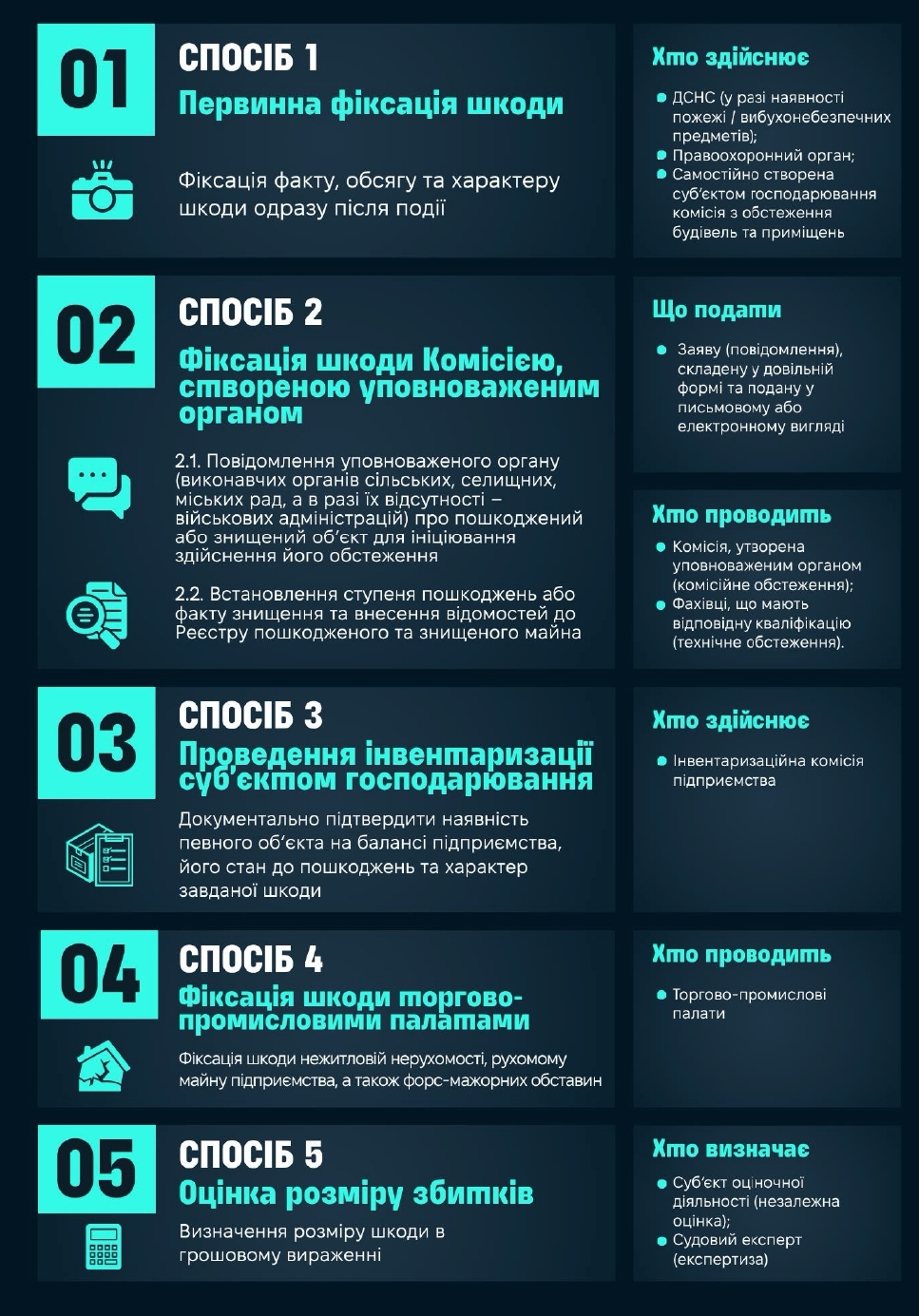
Method 1. Initial Documentation of Damage
Immediately after the property is damaged or destroyed, it is important to document the condition of the property as thoroughly as possible. However, first and foremost, make sure it is safe to be in the vicinity of the property. Do not approach a damaged or destroyed building until all hazards have been eliminated.
What should be done if there is a fire at the site?
Contact the State Emergency Service of Ukraine (SESU) by calling 101.
Will SESU issue documents confirming the fact of the fire?
Yes. SESU prepares a Fire Report and a Report on the Causes of the Fire, which record, among other things, the time, location, causes, circumstances and consequences of the fire (including destroyed and damaged property, losses incurred, etc.).
Can copies of the Fire Report and the Report on the Causes of the Fire be obtained? If so, who can obtain them?
The owner, user, balance holder of the property where the fire occurred, or their duly authorized representative may apply to SESU to obtain a duly certified copy of the report and/or the report on the causes of the fire.
What should be done if an explosive object is discovered on the property?
Contact SESU by calling 101.
What documents does SESU prepare if explosive objects are discovered on the property?
If explosive objects are discovered on the property, a SESU representative prepares an Act on the Implementation of Organizational Measures in the Area Where an Explosive (Suspicious) Object Has Been Detected. The act records information such as the time the report was received, the address, the results of identification, etc.
If the explosive object is subsequently neutralized, an Act on the Completion of Works on Clearing (Demining) the Area of Explosive Objects is prepared. It specifies the area surveyed, the objects detected, and includes a diagram showing the location where the explosive object was found.
Important: The Act on the Completion of Works on Clearing (Demining) the Area of Explosive Objects is important not only in the context of this method of documenting damage to non-residential real estate. An inspection of damaged property by a commission established by an authorized body is carried out after a set of measures has been completed to respond promptly to the detection of explosive objects, conduct inspection (demining), and perform pyrotechnic operations related to the neutralization of detected explosive objects.
Is it necessary to contact law enforcement authorities?
Yes. A law enforcement authority initiates criminal proceedings in connection with the damage to or destruction of non-residential real estate as a result of armed aggression, qualifying the act as a war crime under Article 438 of the Criminal Code of Ukraine.
How should a law enforcement authority be contacted?
In most cases, law enforcement officers arrive at the scene themselves. If they are not present at the scene, the incident can be reported by calling 102. In this case, the duty unit will register the report and forward it to the department within whose jurisdiction the property is located. This can help avoid delays in subsequently transferring the case to the appropriate investigative jurisdiction.
What is the result of contacting a law enforcement authority?
After a statement is submitted, the investigator or prosecutor enters the relevant information into the Unified Register of Pre-Trial Investigations (URPTI) and provides the applicant with an extract from the URPTI.
Another document is the single registration notification slip, which confirms that the statement has been received and registered by the authority to which it was submitted. It usually contains a brief description of the incident and is issued by the duty officer.
In addition, the investigator or prosecutor may conduct an inspection of the scene and prepare a scene inspection report, which also serves as evidence confirming the damage to or destruction of the property.
Is it necessary to obtain victim status in the relevant criminal proceedings?
It is recommended. Victim status, among other things, gives the business entity the right to request an expert examination to determine the amount of damages, as well as to review the materials of the criminal proceedings and make copies of them.
A business entity may obtain victim status by submitting a statement concerning a criminal offense committed against it or an application to be admitted to the proceedings as a victim.
Should the business independently document the damage to its non-residential real estate?
Yes, provided that the security situation allows it. Independent documentation is one of the simplest and most accessible ways of documenting damage. Although it is important to record the condition of the property after the damage occurs and before any works are carried out, personal safety should always take priority.
Who carries out independent documentation of damage to a business entity's non-residential real estate?
A commission for the inspection of buildings and premises established by the business entity itself. The commission conducts an inspection, takes photographs and video recordings, and prepares an inspection report. There is no single approved form, so the business entity develops its own.
Method 2. Documentation of Damage by a Commission Established by an Authorized Body
How can an inspection be initiated?
An inspection may be initiated on the basis of an application (notification) submitted to the authorized body. There is no special prescribed form for such an application, so it may be prepared in any form and submitted in writing or electronically in compliance with the general requirements of legislation on citizens' appeals.
Can an information notification be submitted through the Diia Portal, through an administrator of an Administrative Services Center (ASC), or through a notary?
No. Although Procedure No. 380 provides for the possibility of submitting an information notification through the Diia Portal, an ASC administrator, or a notary, this Procedure does not limit such notifications exclusively to residential property. However, at present, an information notification concerning non-residential real estate cannot be submitted through any of these channels.
What information should be included in the application?
Although the application may be submitted in any form, we recommend including:
- applicant's identification details (full name, contact details, or the business entity's name, including its organizational and legal form, and its EDRPOU identification code);
- information about the real estate (address, type, description, total area, etc.);
- the registration number of the real estate object in the State Register of Rights to Immovable Property, if available;
- information about the damage to the property (date, time, description of the damage, photographs and video recordings, if available).
Is there a statutory deadline for the authorized body to respond?
Unlike an information notification submitted under Procedure No. 380, receipt of which obliges the authorized body to inform the applicant within 10 days about the procedure and timeframe for conducting an inspection, submission of an application (notification) in any form does not impose such an obligation.
What types of inspections are available?
Three types of inspection are provided for. The choice depends on the nature of the damage, the security situation and the location of the property:
- commission inspection — the basic type of inspection, carried out by a commission established by the authorized body;
- technical inspection — carried out where the extent of the damage or the fact that the property has been destroyed cannot be established based on the results of the commission inspection;
- remote inspection — currently does not apply to damaged or destroyed non-residential real estate.
How is a commission inspection conducted?
The authorized body establishes an inspection commission, which visits the property and conducts an inspection. Where possible, authorized representatives of the owner or manager (balance holder) of the property are involved in the commission inspection.
What document is prepared following a commission inspection?
Following the inspection, an Act of Inspection of an Object Damaged as a Result of Military Actions Caused by the Armed Aggression of the Russian Federation (commission inspection act) is prepared.
The act contains, among other things, information about the authorized body, the owner, the characteristics of the damaged property, the extent of the damage and its probable causes, if they can be established, as well as whether a technical inspection is required. The results of photographic documentation of the property demonstrating the nature and extent of the destruction must be attached to the act.
How can a copy of the commission inspection act be obtained?
Where possible, the authorized body informs the owner (manager) of the results of the inspection by sending a copy of the relevant act within 3 calendar days after the act is prepared, or through the Unified State Web Portal of Electronic Services.
If the owner (manager) cannot be identified or their location is unknown, the authorized body provides access to the commission inspection act upon request.
Where is the information contained in the commission inspection act subsequently entered?
The information contained in the commission inspection act is subsequently entered into the Register of Damaged and Destroyed Property.
When is a technical inspection conducted?
A technical inspection of damaged property is mandatory where the extent of the damage or the fact that the property has been destroyed cannot be established based on the results of the commission inspection.
It is conducted by appropriately qualified specialists. The inspection may be commissioned either by the authorized body or by the owner or manager of the property.
Can a technical inspection be conducted solely on the basis of materials without a physical inspection?
No. An inspection cannot be conducted solely on the basis of photographs, video recordings or drawings without a visual inspection of the property.
What document is prepared following a technical inspection?
A technical inspection report is prepared. It must contain a conclusion regarding the technical condition of the property, recommendations concerning its further use or dismantling, and, where necessary, information on damaged (destroyed) load-bearing and enclosing structures, engineering systems, as well as key decisions and recommendations concerning their restoration.
The report is accompanied by a technical inspection act (an act prepared following the inspection of objects damaged as a result of emergencies, military actions or terrorist acts), which must specify the category of damage to the property determined based on the inspection.
Important: A commission established by an authorized body may not refuse to inspect non-residential real estate solely because of the type of property, as Procedure No. 473 does not contain such restrictions.
Method 3. Inventory by the Business Entity
Is an inventory mandatory?
If the damage to or destruction of non-residential real estate was accompanied by a fire, yes, pursuant to Regulation No. 879. In other cases, businesses may also conduct an inventory using this Regulation.
What is the significance of an inventory?
For the purpose of documenting damage to non-residential real estate, an inventory serves as a means of documenting the existence of a particular asset on the company's balance sheet, its condition before the damage, and the nature of the damage caused.
In addition, an inventory covers not only the company's non-residential real estate but also its movable property, making it possible to determine the losses incurred more accurately.
Who conducts the inventory?
The head of the company establishes an inventory commission consisting of representatives of the company's management, accounting department and experienced employees who are familiar with the assets being inventoried, prices and primary accounting records, including engineers, technologists and economists.
The commission is headed by the head of the company, their deputy, or the head of the relevant structural unit.
When is an inventory conducted?
In the event of technological accidents, fires or natural disasters, an inventory is conducted on the day following the end of such events, to the extent determined by the head of the company.
What should be done if the company is located in temporarily occupied territories or areas where hostilities are taking place, or if its property is located in such areas?
In such cases, an inventory is conducted only if safe and unhindered access to the assets and accounting documents is possible.
What should be done if safe and unhindered access to the assets and documents is not possible?
The inventory is conducted as of the first day of the month following the month in which such obstacles cease to exist. The obligation to conduct the inventory is not removed; it is merely postponed.
What documents are prepared as a result of the inventory?
Inventory lists documenting the actual existence of assets and their condition. A separate inventory list is prepared for fixed assets that are unfit for use and cannot be restored, specifying the date they were put into operation and the reasons that rendered them unfit for use.
In addition, the commission prepares minutes containing conclusions regarding discrepancies between the actual existence of assets and liabilities and the accounting records reflected in reconciliation statements, as well as proposals for resolving such discrepancies. The minutes are approved by the head of the company within 5 working days after completion of the inventory.
What should be done if the accounting records were destroyed together with the building?
The head of the company must notify the law enforcement authorities in writing and issue an order establishing a commission to determine which documents are missing and investigate the reasons for their loss or destruction.
Method 4. Documentation of Damage by Chambers of Commerce and Industry
Does the CCI replace other methods of documenting damage to non-residential real estate?
No. The Chamber of Commerce and Industry (CCI) provides an additional method of documenting damage. It does not replace, but rather supplements, the mechanisms described above, including documentation by SESU, law enforcement authorities, and commission and/or technical inspections.
Moreover, documents obtained at earlier stages (in particular, a SESU report) may in some cases be mandatory for a CCI representative to commence work.
What are the advantages for businesses of applying to a CCI?
One advantage of this method is that CCIs document damage not only to non-residential real estate but also to the company's movable property. They also issue certificates confirming the occurrence of force majeure circumstances, which may protect a business entity from liability for failure to perform its obligations.
In addition, where a CCI has a certified appraiser, it may be possible to assess the losses and obtain a property valuation report. Judicial experts may also work with CCIs and conduct forensic examinations, including examinations commissioned by the parties.
How can a business entity initiate the documentation of damage to non-residential real estate using this method?
To document damaged/destroyed real estate, a business entity submits an application for an inspection and documentation of the condition of property lost as a result of the armed aggression of the Russian Federation. In some regions, this is referred to as an application for an inspection of non-residential premises destroyed as a result of the armed aggression of the Russian Federation.
There is no unified application form. However, sample forms are available on the websites of some CCIs, such as the Odesa Regional CCI and the Rivne CCI.
What documents should be attached to the application?
Certified copies of documents confirming ownership of the damaged/destroyed property, technical documentation, and documents confirming the relevant event should be attached to the application.
There is no unified exhaustive list of such documents, as the list depends on the circumstances and specifics of each case. Recommended documents include:
- an extract from the Unified State Register of Legal Entities, Individual Entrepreneurs and Public Organizations;
- a title document for the property (sale and purchase agreement, certificate of ownership, extract from the State Register of Rights to Immovable Property, etc.);
- a technical passport for the real estate (buildings and structures);
- an extract from the URPTI or a scene inspection report issued by the Security Service of Ukraine;
- a fire report issued by SESU, in the event of a fire;
- a commission inspection act for an object damaged as a result of the armed aggression of the Russian Federation, issued by local self-government authorities;
- an inspection act prepared by the company's commission immediately after the incident;
- a diagram showing the locations of the damage, if available;
- video and photographic documentation of the damage and the scene, etc.
Does a CCI expert visit the property?
As a rule, yes. However, safe conditions must be in place for an expert to visit the property. The inspection is conducted after all urgent works have been completed, including demining and emergency rescue operations.
If an explosive object was found at the scene, the CCI must also be provided with the Act on the Completion of Works on Clearing (Demining) the Area of Explosive Objects.
What document does a CCI expert prepare following the inspection and analysis of the documents?
The expert prepares an expert opinion confirming that the damage to or destruction of the property occurred as a result of Russia's armed aggression against Ukraine.
Is this service subject to a fee?
Yes. However, there is no fixed fee. The cost depends on the urgency, scope of work and location of the examination.
Method 5. Assessment of the Amount of Damages
How does the assessment of damages for business entities differ from the assessment of damages for individuals?
Unlike individuals, business entities are subject to a specific Methodology No. 3904/1223, which covers actual losses, lost profits and restoration needs.
This Methodology is mandatory when assessing damages caused to persons affected by armed aggression, as well as when conducting a forensic examination (expert study) related to the assessment of such damages.
What documents are required to conduct an assessment under Methodology No. 3904/1223?
Methodology No. 3904/1223 does not contain an exhaustive list of documents that must be provided for an assessment. Among other things, it states that, when assessing (determining the amount of) damages, it is necessary to obtain a document prescribed by law confirming that the loss, destruction or damage to the property occurred as a result of armed aggression.
The State Property Fund of Ukraine has provided indicative lists of documents that may be used when assessing (determining the amount of) damages caused to enterprises of all forms of ownership as a result of the armed aggression of the Russian Federation.
Documents confirming that the loss, destruction or damage to property occurred as a result of armed aggression include, in particular:
- a fire report;
- an Act on the Completion of Works on Clearing (Demining) the Area of Explosive Objects;
- an extract from the URPTI;
- documents recording the damage, destruction or loss of property prepared by authorized bodies (commissions);
- an inspection report (inspection act) prepared by persons designated under Procedure No. 257;
- inspection acts documenting damage, destruction or loss of property prepared by CCI experts, specialists working for the business entity, other specialists, experts, valuation entities, etc.;
- a scene inspection report prepared by a pre-trial investigation body or prosecutor, access to which is provided in accordance with the procedure established by the Criminal Procedure Code of Ukraine;
- registry data from the Register of Damaged and Destroyed Property.
Important: Thus, the assessment of damages depends on the results of other methods of documenting damage to non-residential real estate. Without obtaining relevant documents confirming the causal link between the damage to or destruction of the property and armed aggression, it is impossible to assess damages under Methodology No. 3904/1223.
In what currency are the assessment results recorded?
Methodology No. 3904/1223 provides for the results of the assessment to be recorded in US dollars, with conversion into the equivalent amount in Ukrainian hryvnia at the exchange rate of the National Bank of Ukraine applicable on the valuation date.
Is a review of the damages valuation report mandatory?
Yes, if the property being assessed is municipal or state-owned property.
Obtaining Partial Compensation for Property of Business Entities Destroyed or Damaged as a Result of the Armed Aggression of the Russian Federation
Who is eligible for partial compensation?
A business entity that has registered for the compensation programme and whose property is located in high-risk areas (the territories of Dnipropetrovsk, Donetsk, Zaporizhzhia, Mykolaiv, Odesa, Poltava, Sumy, Kharkiv, Kherson and Chernihiv regions, excluding temporarily occupied territories).
What are the limitations of this mechanism?
- Compensation is available only for property destroyed or damaged on or after 1 January 2026, provided that the business entity was registered in the programme in advance.
- Participation in the programme is subject to a fee.
- A contribution of 0.5% of the total amount of the estimated loss is payable, but not more than 0.5% of the overall maximum compensation amount.
- The total maximum amount of compensation payable to one business entity throughout the entire period of the programme for damage to or destruction of property may not exceed UAH 30 million.
- Only direct (actual) losses are eligible for compensation.
- Acceptance of compensation applications is suspended if the total amount of applications submitted exceeds the budget appropriations for the relevant year.
How can a business entity register for the programme?
To participate in the property damage/destruction compensation programme, a business entity must:
- Pay the contribution when submitting the application (as described above).
- Submit an application to the private joint-stock company “Export Credit Agency” (ECA) by sending it to info@eca.gov.ua or through the ECA website.
- Attach the required documents, including:
- proof of ownership of the property;
- an extract from the Unified State Register of Legal Entities, Individual Entrepreneurs and Public Organizations concerning the business entity, issued no more than 10 calendar days before the date of submission of the application to the Agency;
- proof of payment of the contribution;
- copies of documents confirming the authority of the person signing the application;
- a copy of the signatory's passport and tax identification number.
Important: Within 30 calendar days, the Export Credit Agency verifies the submitted documents and notifies the applicant of its inclusion in the programme or of the need to correct deficiencies.
Where should the compensation application be submitted?
The compensation application must be submitted to the private joint-stock company “Export Credit Agency” for each damaged or destroyed property after the relevant documents have been entered into the Register of Damaged and Destroyed Property.
What documents are required to receive compensation?
A decision on payment of compensation for damage to or destruction of property is made on the basis of the following documents:
- compensation application;
- documents confirming ownership of the property;
- a certificate confirming the absence of outstanding payments administered by the relevant tax authorities, or an extract from the information system of the State Tax Service concerning the taxpayer's payment status with the state budget and targeted funds;
- photographs of the damaged or destroyed property, if available;
- a commission or technical inspection act for the damaged or destroyed property;
- a report containing a conclusion on the technical condition of the property;
- documents confirming the destruction of or damage to the property, including SESU acts, National Police certificates, fire reports, etc.;
- the technical passport of the property or part thereof;
- a property valuation act and valuation report;
- documents confirming the authority and identity of the person signing the compensation application.
Practical Evidence Matrix
The documents collected at each stage of the damage documentation process form an evidentiary record that may be used to obtain compensation in the future. The indicative matrix below can help determine what evidence is needed to establish each element: ownership of the property, the fact of damage or destruction, the causal link between the damage and armed aggression, and the amount of losses.

Register of Damage Caused by the Aggression of the Russian Federation Against Ukraine
Difficulties in completing national procedures for documenting damage to non-residential real estate should not discourage affected persons from submitting claims to the Register of Damage Caused by the Aggression of the Russian Federation Against Ukraine (the Register of Damage for Ukraine), which is the first component of the future international compensation mechanism. The Register serves to document claims, evidence and information concerning damage, loss or harm caused by the full-scale invasion.
The approach of the Register of Damage for Ukraine is more flexible than certain national procedures. For claims under categories A3.2 “Damage or Destruction of Non-Residential Immovable Property,” C1.1 and C1.2 “Damage or Destruction of Critical and Non-Critical Infrastructure,” C1.5 “Damage or Destruction of Non-Residential Immovable Property (Not Related to Business Losses),” C2 “Loss, Damage or Destruction of Cultural Property and Buildings,” and C3.1 “Damage, Destruction or Loss of Assets,” the availability of a commission inspection act, a damages valuation report or any other document obtained through national procedures is not mandatory.
Claimants may submit the evidence and documents available to them and supplement their claim with additional evidence after submission. Therefore, the absence of certain documents or difficulties in completing national procedures should not be regarded as an obstacle to submitting a claim to the Register of Damage for Ukraine.
Website: Register of Damage for Ukraine
Frequently Asked Questions — Category A3.2 “Damage or Destruction of Non-Residential Immovable Property”:
A3.2 FAQ
Frequently Asked Questions — Categories C1.1 and C1.2 “Damage or Destruction of Critical and Non-Critical Infrastructure”:
C1.1/C1.2 FAQ
Frequently Asked Questions — Category C3.1 “Damage, Destruction or Loss of Assets”:
C3.1 FAQ
Register of Damage for Ukraine
Категорія: А3.2. Пошкодження або знищення нежитлового нерухомого майна
Category A3.2. Damage or Destruction of Non-Residential Immovable Property
What type of damage does this category cover?
Only the value of destroyed property or the cost of repairing or reconstructing damaged non-residential immovable property.
Who is eligible to submit a claim?
An individual who owns non-residential immovable property located in Ukraine.
Important
A claim concerning non-residential immovable property used for commercial purposes may be submitted under this category if the property was owned by an individual. However, such a claim may cover only the value of the property or the costs of its repair.
If your claim also concerns other losses, such as lost profits resulting from the damage to or destruction of the property, you should also submit a claim under another relevant category, such as A3.5 (Loss of Private Entrepreneurship).
What information and documents should be provided?
- Documents confirming ownership.
- Information from Ukraine's Register of Damaged and Destroyed Property, including, where available, the Commission Inspection Act, Technical Inspection Report, Valuation Act and Property Valuation Report.
- A description of the event that caused the damage/destruction (type, date and description of the event).
- Information about the damage to or destruction of the property (type, extent and description).
- Evidence of the damage or destruction (photographs, videos).
- An expert assessment of the losses, if available.
- Evidence of the value of the property as of 24 February 2022.
- Evidence of repairs carried out and their cost.
- Information about any compensation received from the state.
- The estimated amount of the claim.
- Information about relevant court proceedings or law enforcement investigations, if available.
- Any other evidence relating to the claimant, the event, the damage or destruction of the property, the value of the real estate, etc.
Category C1.1, C1.2. Damage or Destruction of Critical and Non-Critical Infrastructure
What type of damage does this category cover?
Only the value of destroyed property or the cost of repairing or restoring damaged infrastructure or its functions.
What falls within the definition of “infrastructure”?
Assets, facilities, structures or systems, whether tangible or intangible, that:
- contribute to the functioning of the State of Ukraine and its society;
- provide functions or services;
- are intended for use by or for the benefit of the population.
What is considered critical infrastructure?
Infrastructure elements that:
Are essential for:
- the vital interests of the State of Ukraine (the economy, security or defence); and/or
- ensuring vital functions or services for society.
And are characterized by the fact that they:
- may exist independently or in interaction with other infrastructure;
- if their functioning is disrupted, or if they become unusable or are destroyed, have or may have a significant impact on the provision of important functions and services.
In which sectors can infrastructure be considered critical?
Public safety:
- civil protection of the population and territories and rescue services;
- defence and state security;
- law enforcement, administration of justice and detention.
Public administration:
- governance and provision of essential public (administrative) services.
Economy and finance:
- food supply;
- financial services.
Information and communications:
- information services;
- electronic communications.
Utilities:
- energy supply, including heat supply;
- water supply and wastewater management.
Science and industry:
- space activities, space technologies and services;
- chemical industry;
- research activities.
Healthcare and biosecurity:
- healthcare;
- pharmaceutical industry;
- vaccine production and sustainable operation of biological laboratories.
Transport and logistics:
- transport infrastructure and services.
What is considered non-critical infrastructure?
Infrastructure that does not fall within the definition of critical infrastructure — that is, anything that does not meet the criteria for “critical infrastructure.”
Who is eligible to submit a claim?
Legal entities and institutions that are owned or controlled by Ukraine (including its regional or local authorities), or that, under Ukrainian law, have the right of economic management, operational management or usufruct in respect of the relevant infrastructure.
Important
A detailed description of all components of the claim must be provided.
What information should be provided?
- Information about the type of infrastructure.
- A description of the event that damaged or destroyed the infrastructure (type, date and description of the event).
- Evidence of the damage or destruction.
- Evidence of an expert assessment of the losses.
- The assessed amount of the losses.
- Evidence of the value of the property as of 24 February 2022.
- Evidence of repairs carried out and their cost.
- Information on the estimated amount of the claim and a detailed description of the claim.
- Information about relevant court proceedings or law enforcement investigations, if available.
Category C1.5. Damage or Destruction of Non-Residential Immovable Property (Not Related to Business Losses)
What type of damage does this category cover?
Only the value of destroyed property or the cost of repairing or reconstructing damaged property.
What is considered non-residential immovable property for the purposes of this category?
Non-residential immovable property not intended for generating profit.
Who is eligible to submit a claim?
Legal entities and institutions that are owned or controlled by Ukraine (including its regional or local authorities), or that, under Ukrainian law, have the right of economic management, operational management or usufruct in respect of the relevant property.
What information should be provided?
- Information about the real estate (type, location, area, floor, etc.).
- Information from Ukraine's Register of Damaged and Destroyed Property, including, where available, the Commission Inspection Act, Technical Inspection Report, Valuation Act and Property Valuation Report.
- A description of the event that caused the damage/destruction (type, date and description).
- Information about the damage to or destruction of the property (type, extent and description).
- Evidence of the damage or destruction (photographs, videos).
- An expert assessment of the losses, if available.
- Evidence of the value of the property as of 24 February 2022.
- Evidence of repairs carried out and their cost.
- Information about compensation received from the state.
- The estimated amount of the claim.
- Information about relevant court proceedings or law enforcement investigations, if available.
- Any other evidence relating to the claimant, the event, the damage to or destruction of the real estate, the value of the property, etc.
Category C2. Loss, Damage or Destruction of Cultural Property and Buildings
What type of damage does this category cover?
The value of damaged, destroyed or lost cultural property or buildings; the cost of repairing or reconstructing damaged cultural property or buildings; and any costs incurred in connection with the restoration and recovery of such property.
What is considered cultural property or buildings?
Movable and immovable property of artistic, historical, religious, ethnographic or scientific importance, including, but not limited to:
- works of architecture, monumental sculpture and painting; elements and structures of historical or archaeological interest; cave inscriptions; and groups of elements of outstanding historical, artistic or scientific value;
- groups of separate or interconnected buildings whose architecture, unity or relationship with the landscape has outstanding universal value from the perspective of history, art or science;
- objects or buildings whose primary and actual purpose is to protect, preserve or exhibit movable or intangible cultural heritage, such as museums, major libraries and archival repositories, as well as shelters intended to preserve cultural property in the event of armed conflict;
- works created by humans or joint works of humans and nature, as well as areas, including archaeological sites, of universal value from the perspective of history, aesthetics, ethnology or anthropology; and
- movable works of art, including, but not limited to, works of art (paintings, graphics and sculpture, artistic compositions and ensembles made from various materials, traditional folk art and crafts), manuscripts, archives, books and other objects associated with historical events, prominent national figures, political parties, public and religious organizations, science, culture and the arts, literary value, as well as unique and rare musical instruments.
An object or building that is or was included on the UNESCO World Heritage List or the Emergency Red List of Cultural Objects at Risk is considered cultural property.
Who is eligible to submit a claim?
Legal entities and institutions that are owned or controlled by Ukraine (including its regional or local authorities), or that, under Ukrainian law, have the right of economic management, operational management or usufruct in respect of the relevant property.
Important
If a lost cultural property is recovered, the claimant is required to notify the Register.
All relevant supporting Evidence must be submitted, together with information detailing the claim and the methodology used to determine its estimated amount.
A detailed description of the components of the claim may be provided.
What information should be provided?
- Information about the cultural property or building (name, type, location, geographical coordinates, evidence of its cultural value, etc.).
- Information from the Register of Damaged and Destroyed Property, if available.
- A description of the event that caused the damage, destruction or loss of the cultural property or building (type, date and description).
- Information about the damage to or destruction of the cultural property or building (type, extent, description and evidence).
- Evidence of the value of the cultural property or building as of 24 February 2022.
- Evidence of an official assessment of the losses and the assessed amount of losses, if available.
- Evidence of repairs carried out and their cost, if available.
- The estimated amount of the claim.
- Information about relevant court proceedings or law enforcement investigations, if available.
- Any other evidence relating to the claimant, the event, the damage to or destruction of the cultural property or building, the value of such property, etc.
Category C3.1. Damage, Destruction or Loss of Assets
What type of damage does this category cover?
Damage to, destruction or loss of assets; loss of profits generated by the relevant assets; total loss of a business; and other direct costs incurred as a result of such damage, destruction or loss.
What is considered an asset?
Any tangible or intangible value that generates economic benefits, or from which economic benefits are expected to be generated, for its owner(s).
Who is eligible to submit a claim?
Legal entities and institutions that are owned or controlled by Ukraine (including its regional or local authorities), or that, under Ukrainian law, have the right of economic management, operational management or usufruct in respect of the relevant property.
Important
Claims concerning damage to or destruction of infrastructure or residential immovable property may also be submitted under another relevant category (C1.1, C1.2, C1.3 or C1.4). In such cases, any claims concerning loss of profits and other direct costs incurred as a result of such damage to or destruction of infrastructure or residential immovable property should be submitted under this category (C3.1).
All relevant supporting Evidence must be submitted, together with information detailing the claim and the methodology used to determine its estimated amount.
A detailed description of the components of the claim should be provided.
What information should be provided?
- Information about the asset (type, location and detailed description).
- A description of the event that caused the damage, destruction or loss of the asset (type, date and description).
- Information about the damage to, destruction or loss of the asset (type, extent, description and evidence).
- The estimated amount of the claim.
- Information about relevant court proceedings or law enforcement investigations, if available.
Related analytics