

How to document damage to non-residential real estate of individuals?
Authors: Andriy Klymosyuk, Oksana Huzii, Bohdan Karnaukh
Publisher: Analytical Centre "Institute of Legislative Ideas". All rights reserved.
The document was prepared with the support of the International Renaissance Foundation. The material reflects the position of the authors and does not necessarily coincide with the position of the International Renaissance Foundation.


Analytics content

Who are these practical recommendations for?

For individuals whose non-residential property, such as garages, sheds, cellars, summer kitchens, warehouses, and similar facilities, has been damaged or destroyed as a result of Russia’s aggression.
Why should damage be documented?
Proper documentation of damage is a prerequisite for receiving compensation in the future. Although Ukraine has not yet established a national compensation mechanism for non-residential property owned by individuals that has been damaged or destroyed, the damage should be documented as early as possible.
The condition of a property changes over time due to weather exposure and other factors. As time passes, it becomes more difficult to prove both that the damage was caused by the armed aggression and the actual monetary value of the losses incurred.
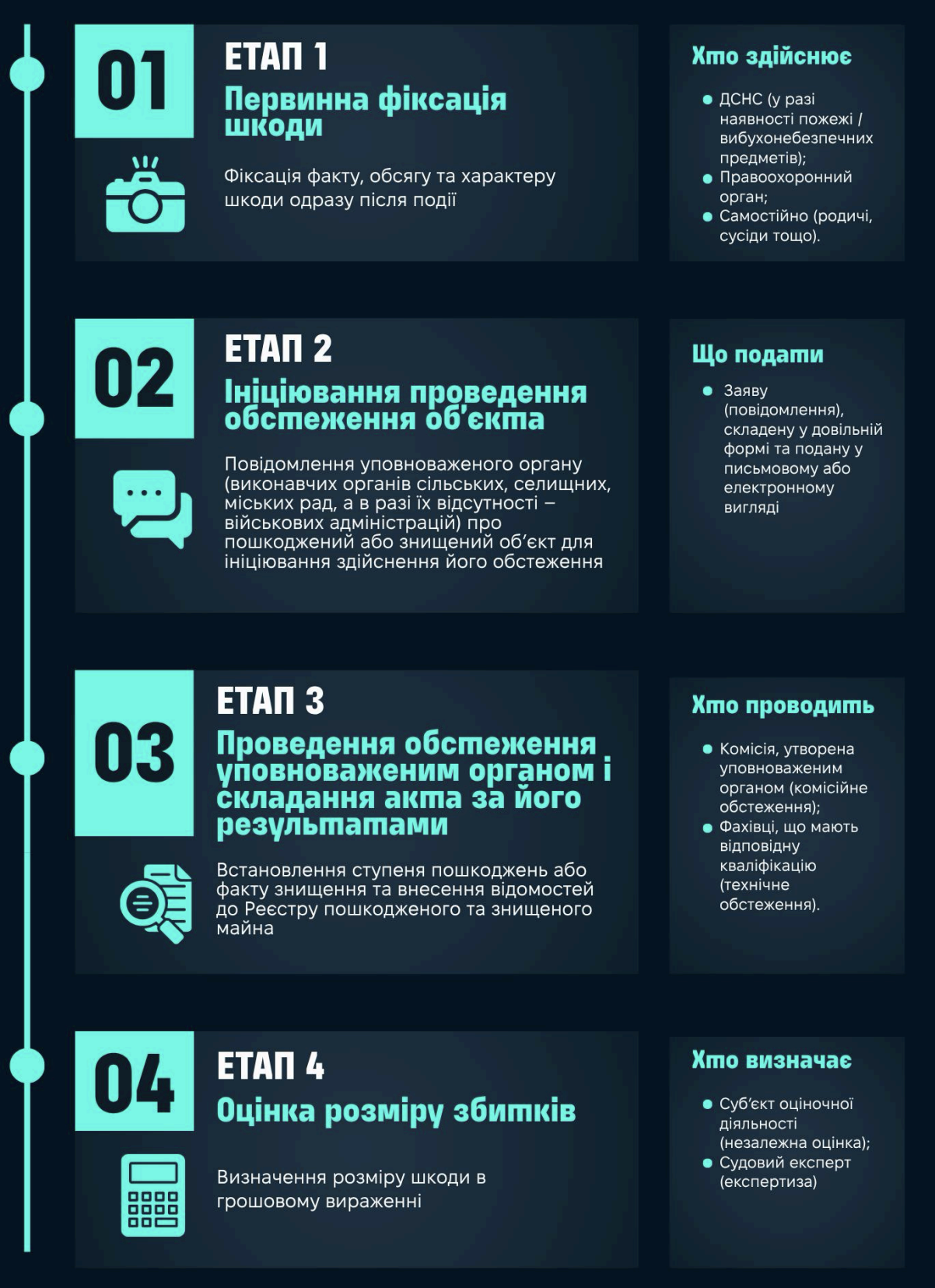
Stage 1. Initial documentation of damage
Immediately after non-residential property has been damaged or destroyed, its condition should be documented in as much detail as possible. However, the first priority is to make sure that it is safe to remain near the property. Do not approach a damaged or destroyed building until all hazards have been eliminated.
- What should you do if there is an ongoing fire at the site?
Contact the State Emergency Service of Ukraine (SESU) by calling 101.
- Will the SESU provide documents confirming that a fire occurred?
Yes. The SESU prepares a fire report and a conclusion on the cause of the fire. These documents record, among other things, the time, location, causes, circumstances and consequences of the fire, including destroyed or damaged property and the losses caused.
- Can copies of the fire report and the conclusion on the cause of the fire be obtained? If so, who is entitled to receive them?
The owner, user or balance holder of the property where the fire occurred, or their duly authorized representative, may apply to the SESU for a certified copy of the fire report and/or the conclusion.
- What should you do if an explosive object is discovered on the property?
Contact the SESU by calling 101.
- What documents does the SESU prepare if explosive objects are discovered on the property?
If explosive objects are discovered on the property, an SESU representative prepares a Report on Organisational Measures Taken in the Area Where an Explosive or Suspicious Object Was Detected. The report includes information on the time the notification was received, the address, the identification results and other relevant details.
If the explosive object is subsequently neutralised, a Report on Clearance (Demining) of the Area from Explosive Objects is prepared. It includes information on the area inspected, the objects detected and a diagram showing the location where the explosive object was found.
! The Report on Clearance (Demining) of the Area from Explosive Objects is relevant beyond the initial stage of documenting damage to non-residential property. An inspection of a damaged property by a commission established by the authorised body may only be carried out after the necessary emergency response measures have been completed, including inspection and demining of the area and pyrotechnic works required to neutralise detected explosive objects.
- Should law enforcement authorities be contacted?
Yes. A law enforcement authority initiates criminal proceedings concerning damage to or destruction of non-residential property resulting from armed aggression and classifies the act as a war crime under Article 438 of the Criminal Code of Ukraine.
- How should a law enforcement authority be contacted?
In most cases, law enforcement officers arrive at the scene on their own initiative. If they are not present, the incident may be reported by calling 102. The duty unit will register the report and forward it to the competent territorial department responsible for the location of the property. This may help avoid subsequent delays caused by transferring the case between investigative authorities.
- What is the result of contacting a law enforcement authority?
After a statement is submitted, an investigator or prosecutor enters the relevant information into the Unified Register of Pre-Trial Investigations and provides the applicant with an extract from the Register.
Another relevant document is the notification slip from the Unified Record System, which confirms that the authority has received and registered the statement and contains a brief description of the incident. As a rule, this document is issued by the duty officer.
In addition, an investigator or prosecutor may inspect the scene and prepare an inspection record. This document may also serve as evidence confirming that the property was damaged or destroyed.
- Should the owner obtain victim status in the relevant criminal proceedings?
This is recommended. Victim status provides, among other rights, the right to request an expert examination to determine the amount of losses and the right to review the case materials and make copies of them.
A person may obtain victim status by filing a statement concerning a criminal offence committed against them or an application to be recognised as a victim in the proceedings.
- Should damage to non-residential property be documented independently?
Yes, but only where the security situation allows it. Independent documentation is one of the simplest and most accessible ways to record damage.
Although the condition of the property should ideally be documented immediately after the damage occurs and before any repair or other works are carried out, personal life and health should not be put at risk. Documentation may be carried out by the owner, neighbours, relatives or other persons.
- How should photos and videos be taken?
Panoramic images should be taken to show the overall scale of destruction, including images that make it possible to identify the geographical location. Individual details of the damage or consequences of destruction should also be recorded separately.
When recording video, it is advisable to state the identifying details of the person making the recording, as well as the time, date, location and geolocation data.
Once the documentation has been completed, the files should not be altered, as any changes may adversely affect their evidentiary value when proving damage to the property.
It is advisable to use the eyeWitness to Atrocities application. It records geolocation, date and location information and protects the captured material from undetected alteration.
- Can witness statements be documented?
Yes. Witness statements may be recorded on video or provided in writing. The witness’s identifying information, including full name and contact details, should be recorded. Written statements should be signed by the witness.
Stage 2. Initiating an inspection of the property
Why should the authorised body be notified?
The purpose is to ensure that the authorised body, namely the executive bodies of village, settlement or city councils or, where such bodies are absent, military administrations, becomes aware of the damaged or destroyed property and arranges its inspection.
Can an information notice be submitted through the Diia Portal, an administrator of an Administrative Service Centre or a notary?
No. Although Procedure No. 380 provides for the possibility of submitting an information notice through the Diia Portal, an administrator of an Administrative Service Centre or a notary, the Procedure does not limit such notices exclusively to residential property.
However, at present, an information notice concerning non-residential property cannot be submitted through any of these channels.
How can an inspection be initiated instead?
An inspection may be initiated on the basis of an application or notice submitted to the authorised body.
No specific form has been established for such an application or notice. It may therefore be submitted in free form, either in writing or electronically, subject to the general requirements of legislation governing citizens’ appeals.
What information should be included in the application?
Although the application may be submitted in free form, we recommend including:
- the applicant’s identifying information, including full name and contact details
- information about the property, including its address, type, description and total area
- the registration number of the immovable property in the State Register of Rights to Immovable Property, if available
- information about the damage, including the date, time and description of the damage, as well as photographs or video recordings, if available
! Under Part 7 of Article 5 of the Law of Ukraine “On Citizens’ Appeals”, an appeal must indicate the citizen’s surname, first name and patronymic, place of residence, the substance of the issue raised, comments, proposals, applications or complaints, and the request or demand. A written appeal must be signed and dated by the applicant or applicants. An electronic appeal must also specify an email address to which a response may be sent or provide information about other means of contacting the applicant. A qualified electronic signature is not required when submitting an electronic appeal.
Is there a statutory deadline for the authorised body to respond?
Unlike an information notice submitted under Procedure No. 380, receipt of which requires the authorised body to inform the applicant within 10 days about the method and timeframe for conducting the inspection, a free-form application or notice does not trigger the same obligation.
At the same time, such applications are subject to the general requirements of the Law of Ukraine “On Citizens’ Appeals”. Under this Law, appeals must generally be considered within no more than one month from the date of receipt. Appeals that do not require additional examination must be considered within 15 days of receipt.
Stage 3. Inspection by the authorised body and preparation of an inspection report
What types of inspection are available?
Three types of inspection are provided for. The appropriate type depends on the nature of the damage, the security situation and the location of the property:
- commission inspection – the standard form of inspection carried out by a commission established by the authorised body
- technical inspection – carried out where a commission inspection does not make it possible to determine the extent of the damage or whether the property has been destroyed
- remote inspection – currently not applicable to damaged or destroyed non-residential property
How is a commission inspection conducted?
The authorised body establishes an inspection commission, which visits the property and conducts an on-site inspection.
Where possible, authorised representatives of the owner or the property manager or balance holder are involved in the commission inspection.
What document is prepared following a commission inspection?
Following the commission inspection, a Report on the Inspection of Property Damaged as a Result of Hostilities Caused by the Armed Aggression of the Russian Federation is prepared.
The report includes, among other things, information about the authorised body, the owner, the characteristics of the damaged property, the extent and likely causes of the damage where these can be determined, and whether a technical inspection is required.
Photographic evidence demonstrating the nature and extent of the destruction must be attached to the report.
How can a copy of the commission inspection report be obtained?
Where possible, the authorised body informs the owner or property manager of the inspection results by sending a copy of the relevant report within three calendar days after it is prepared or by making it available through the Unified State Web Portal of Electronic Services.
If information about the owner or property manager is unavailable, or their location is unknown, the authorised body must provide access to the commission inspection report upon request.
Where is the information contained in the commission inspection report subsequently entered?
The information contained in the commission inspection report is subsequently entered into the Register of Damaged and Destroyed Property.
When is a technical inspection conducted?
A technical inspection of damaged property is mandatory where the results of the commission inspection do not make it possible to determine the extent of the damage or whether the property has been destroyed.
The technical inspection is carried out by appropriately qualified specialists. It may be commissioned either by the authorised body or by the owner or property manager.
Can a technical inspection be conducted solely on the basis of materials without a physical inspection of the property?
No. An inspection may not be conducted exclusively on the basis of photographs, video recordings or drawings without a visual inspection of the property.
What document is prepared following a technical inspection?
Following the inspection, a technical inspection report is prepared. It must contain a conclusion on the technical condition of the property, recommendations regarding its further use or demolition and, where necessary, information about damaged or destroyed load-bearing and enclosing structures and engineering systems, as well as proposed solutions or recommendations for their restoration.
A technical inspection act must be attached to the report. This is an act prepared following an inspection of property damaged as a result of emergencies, hostilities or terrorist acts. It must specify the category of damage assigned to the property based on the inspection results.
! A commission established by the authorised body may not refuse to inspect non-residential property solely because of the type of property, as Procedure No. 473 does not establish such a restriction.
Stage 4. Assessment of the amount of losses
Why is an assessment of the amount of losses necessary?
The documents obtained during the previous stages confirm that non-residential property has been damaged or destroyed. However, in order to claim compensation in the future, the monetary value of the losses must also be assessed.
What methods can be used to assess the losses?
The main methods are:
- an independent property valuation carried out by a licensed valuation professional under a contract
- an expert examination conducted on the basis of a decision by an investigator or prosecutor in criminal proceedings, or under a contract between the affected person and an expert or expert institution
What is the difference between these methods?
One of the differences is the time required to complete the assessment. Given the workload of expert institutions, an expert examination may take longer.
However, where an expert examination is ordered within criminal proceedings, it may be conducted at no cost to the affected person.
What documents are required for an assessment?
Current legislation does not establish an exhaustive list of documents required for an assessment. An indicative list may include:
- documents confirming title to the immovable property, such as a sale and purchase agreement, a court decision or a certificate of inheritance
- the technical passport for the property
- reports and other documents confirming that the damage was documented, including those referred to in the previous stages
! The complete list of documents required for an assessment should be confirmed directly with the valuation professional or expert before the assessment is carried out.
What documents are prepared following an assessment?
An independent property valuation conducted by a valuation professional results in a property valuation report.
An expert examination results in an expert opinion.
What must a victim do to have an expert examination conducted within criminal proceedings?
If the owner of damaged or destroyed property has been recognised as a victim in the relevant criminal proceedings, they may submit a request to the investigator and/or prosecutor asking for an expert examination to be ordered.
The final decision on whether to order the expert examination is made by the prosecution.
Can a victim make copies of an expert opinion obtained within criminal proceedings?
Yes. A victim has the right to make copies of and extracts from such materials.
However, written permission from the investigator or prosecutor must be obtained before a copy of the expert opinion is used for other purposes, as it may contain information covered by the confidentiality of the pre-trial investigation.
! There is currently no specific methodology for assessing losses to non-residential property owned by individuals. Such losses are assessed in accordance with the general valuation standards.
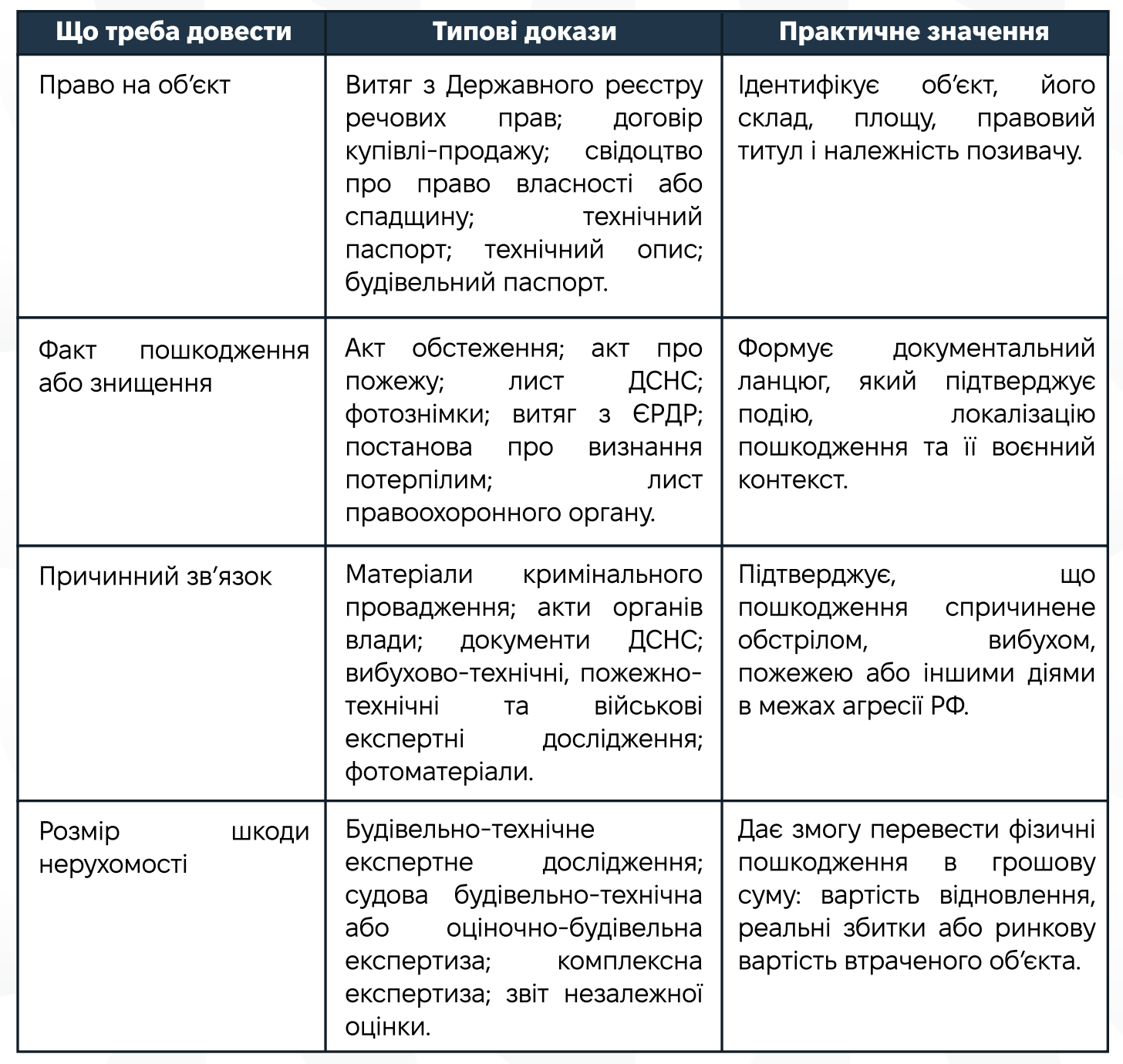
Practical evidence matrix
The documents collected at each stage of the documentation process form an evidentiary basis that may be used to claim compensation in the future.
The indicative matrix below helps identify which evidence may be needed to establish each key element: ownership of the property, the fact that it was damaged or destroyed, the link between that damage or destruction and the armed aggression, and the amount of losses incurred.
Documenting damage at the international level by submitting a claim to the Register of Damage Caused by the Aggression of the Russian Federation against Ukraine
Difficulties in completing national procedures for documenting damage to non-residential property should not discourage affected persons from submitting claims to the international Register of Damage Caused by the Aggression of the Russian Federation against Ukraine (hereinafter, the Register of Damage for Ukraine), which is the first component of the future international compensation mechanism.
The Register serves as a documentary record of claims, evidence and information concerning damage, loss or injury caused by Russia’s full-scale invasion of Ukraine.
The approach applied by the Register of Damage for Ukraine is more flexible than certain national procedures. To submit a claim under Category A3.2, “Damage or destruction of non-residential immovable property”, it is not mandatory to provide a commission inspection report, a damage assessment report or any other document obtained through national procedures.
Affected persons may submit the evidence and documents available to them and supplement their claim with additional evidence after submission. Therefore, the absence of certain documents or difficulties in completing national procedures should not be regarded as an obstacle to submitting a claim to the Register of Damage for Ukraine.
Website: https://rd4u.coe.int/uk/home
Frequently asked questions on Category A3.2, “Damage or destruction of non-residential immovable property”: https://rd4u.coe.int/uk/a3.2-damage-or-destruction-of-non-residential-immovable-property1
Register of Damage for Ukraine
Category A3.2. Damage or destruction of non-residential immovable property
- What type of damage does this category cover?
Only the value of destroyed property or the cost of repairing or rebuilding damaged non-residential immovable property.
- Who is eligible to submit a claim?
An individual who owns non-residential immovable property located in the territory of Ukraine.
- What information and documents should be provided?
- Documents confirming ownership of the property.
- Information from the Register of Damaged and Destroyed Property of Ukraine, including a commission inspection report for damaged or destroyed property, a technical inspection report, a valuation act and a property valuation report, where available.
- A description of the event that caused the damage or destruction of the property, including the type, date and description of the event.
- Information on the damage to or destruction of the property, including its type, extent and description.
- Evidence of the damage or destruction, such as photographs and video recordings.
- An expert assessment of the losses, where available.
- Evidence of the value of the property before 24 February 2022.
- Evidence of repair works carried out and their cost.
- Information on any compensation received from the state.
- The estimated amount claimed.
- Information on relevant court proceedings or law enforcement investigations, where available.
Related analytics