


>
Analytics>
Valuation of seized assets following changes to the procedure for transferring assets to ARMA for managementValuation of seized assets following changes to the procedure for transferring assets to ARMA for management
This research was prepared by the Institute of Legislative Ideas (ILI) with the support of the Organized Crime and Corruption Reporting Project (OCCRP) as part of the project “Closing the Gaps: Monitoring ARMA to Prevent the Diversion of Sanctioned and Corruption-Related Assets.”
The Institute of Legislative Ideas focuses on the practical aspects of transferring seized assets into management, including for their subsequent sale. The analysis examines the types of assets transferred into management, common challenges encountered at different stages of the process, and systemic factors that hinder effective asset management. Based on the monitoring findings, recommendations have been developed to improve the relevant procedures and regulatory framework.
The views expressed in this publication are those of the authors and do not necessarily reflect the views of the Organized Crime and Corruption Reporting Project (OCCRP).


Analytics content

Executive Summary

This brief examines 27 procurements of valuation services for seized assets announced by ARMA in June-August 2026, as well as an earlier attempt to conclude a framework agreement for the valuation of a pool of assets. The procurements cover real estate, corporate rights and property complexes, vessels, railway rolling stock, and commodity and agricultural assets. As of 31 August, contracts had been concluded under 17 procedures, winner selection was ongoing under 7, bids had been reviewed under another 2, and bid submission was ongoing under one. Competition was generally sufficient: most procurements attracted between 2 and 8 bidders, most commonly 4-5, with only four procedures having a single bidder.
At the same time, the first attempt to establish a systematic valuation mechanism through a framework agreement was unsuccessful because no bidders participated. ARMA consequently moved to separate procurements for specific assets. This made each procedure more transparent but also fragmented the process, increased the administrative burden, and created a risk of delays in preparing assets for transfer into management. Conducting a public procurement procedure does not, in itself, guarantee the appropriate quality of the valuation.
The key risks remain the quality of valuations and insufficient traceability of certain stages in the transfer of assets to ARMA. Vessels, hotel complexes, corporate rights, railway wagons, and agricultural products require different expertise and verification of their actual condition. Selection primarily on price, inadequate asset descriptions, or remote valuations without proper verification may lead to inaccurate conclusions. Meanwhile, the absence of publicly available asset handover and acceptance certificates makes it impossible to establish whether ARMA actually accepted the assets, verify compliance with deadlines for initiating valuations, or determine the time taken to move between stages.
To mitigate these risks, ARMA should determine its future procurement model for valuation services; standardize asset descriptions and approaches to calculating the estimated cost of services; establish clear qualification requirements for complex assets; and ensure public traceability of key stages, including asset handover and acceptance certificates documenting transfer to ARMA. Assets that rapidly lose value require enhanced verification of their actual condition. Valuation results should be used in selecting asset managers to determine asset value, maintenance costs, expected returns, and risks of value loss.
Main analysis
1. Context of ARMA reform and the new procedure for selecting valuation service providers
In 2025-2026, the system for managing seized assets transferred to the Asset Recovery and Management Agency of Ukraine (ARMA) underwent reform. The reform changed approaches to accepting assets for management, determining their suitability for management, selecting asset managers, monitoring management performance, and ARMA reporting.
Asset valuation is particularly important under the updated procedure. It provides the starting point for determining the subsequent management method, expected economic return, terms of the selection procedure for an asset manager, and monitoring the preservation of asset value. If a valuation is conducted as a formality, with delays, or without accounting for the asset’s specific characteristics, this may affect the entire subsequent management cycle: from the terms of the selection procedure to the ability to establish whether the asset loses value while under management.
The revised Article 19 of the Law on ARMA also establishes a clear sequence between the actual acceptance of an asset and its valuation. ARMA accepts assets from a prosecutor pursuant to a handover and acceptance certificate. If the property has not been valued, or more than six months have elapsed since the valuation report was prepared, ARMA must initiate a new valuation no later than three business days after signing the relevant certificate. The valuation service provider is selected in accordance with the Law of Ukraine «On Public Procurement».
Following the procedural changes, ARMA first unsuccessfully announced a tender to conclude a framework agreement for the valuation of a pool of assets, and then began announcing separate procurements for independent asset valuation services through Prozorro.
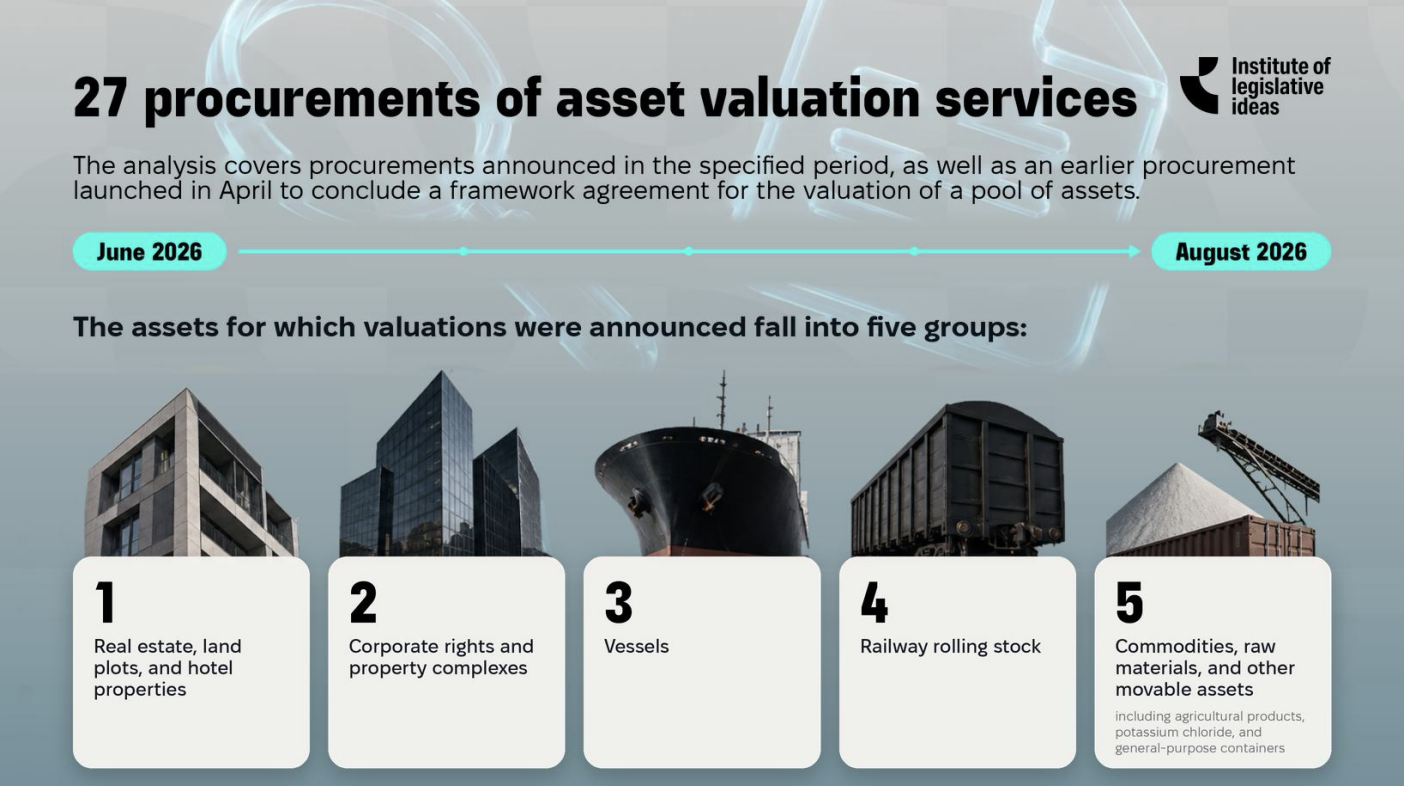
This brief examines 27 procurements of asset valuation services announced in Jun-August 2026, as well as an earlier procurement launched in April to conclude a framework agreement for the valuation of a pool of assets.
2. Framework agreement for valuation of a pool of assets
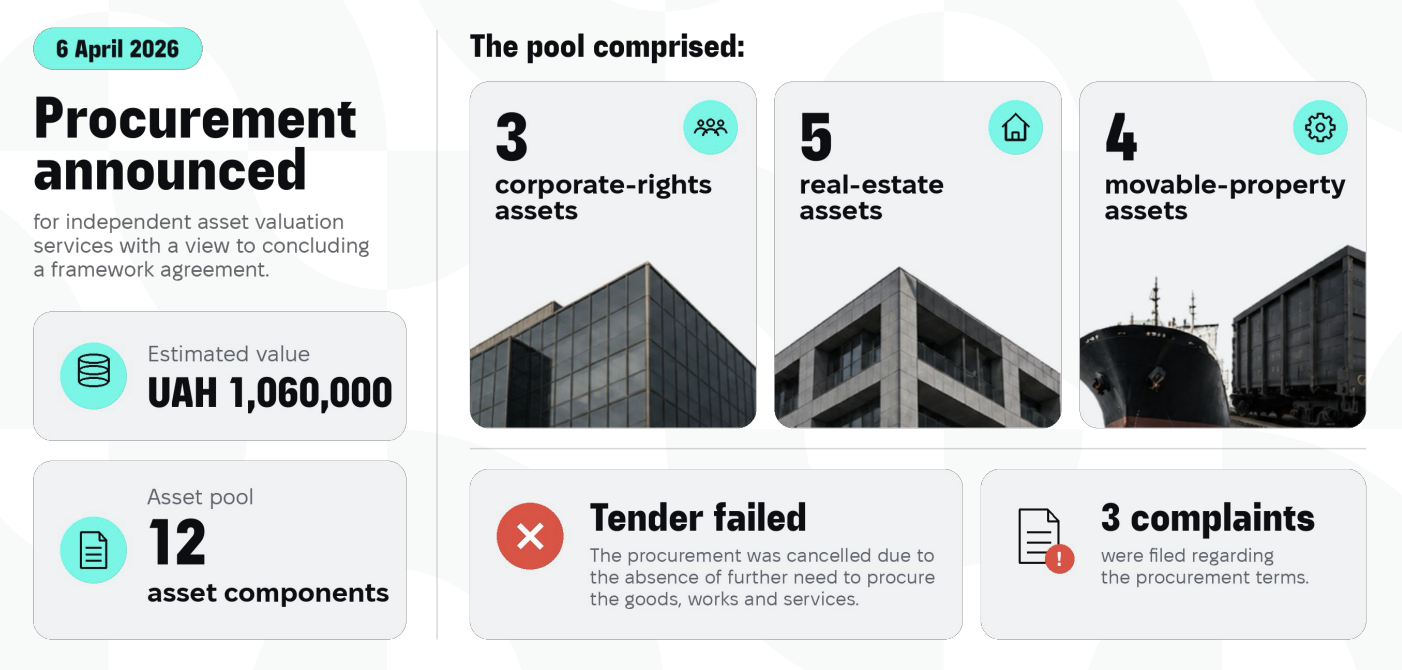
During the bid submission period, prospective bidders filed three complaints, two of which resulted in the correction of violations, while one was withdrawn. Ultimately, no framework agreement was concluded because there were no bidders.
This situation has practical implications. A framework agreement could have given ARMA rapid and standardized access to valuation services for different types of assets.
Instead, the Agency subsequently announced a series of separate procurements for specific assets. This approach increases the transparency of each individual tender but creates an additional administrative burden, increases the number of procedures, and may affect the timeframe for preparing assets for transfer into management.
3. Assets covered by separate procurements of valuation services
The link provides a consolidated list of 27 procurements announced in June-August 2026. The amounts indicated represent the estimated cost of valuation services, not the value of the assets themselves.
The announced procurements cover assets of very different types. Some are real estate or property complexes; others are railway rolling stock, vessels, or commodity assets. This means that a single substantive valuation model cannot be applied to all of them. For hotel properties, relevant factors include the legal status of the premises, technical condition, potential profitability, restrictions on use, encumbrances, and the market for comparable commercial real estate. Vessels and railway wagons require specialized data on technical condition, registration, operability, location, storage costs, and liquidity. For commodity assets, quantity, quality, storage conditions, shelf life, and the risk of deterioration in their marketable characteristics are important.
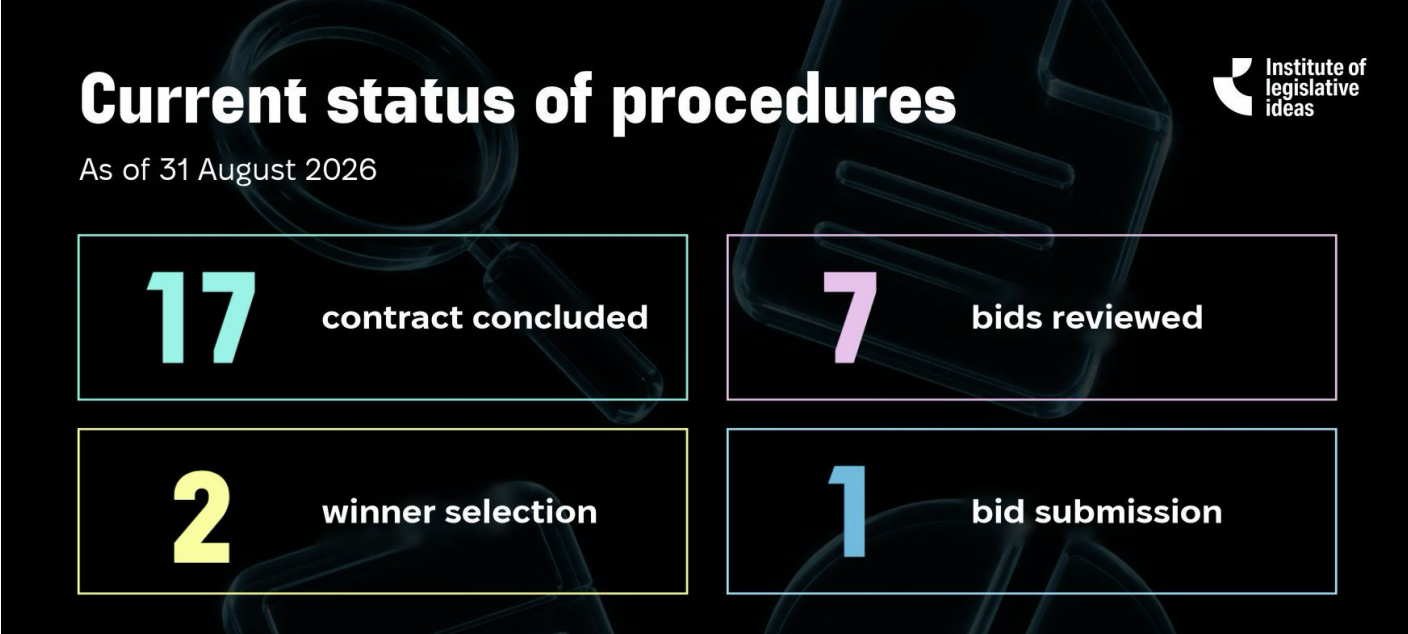
Under one of the two procedures in which bids had already been reviewed, contract signing was pending. The other procedure had been cancelled because there was no longer a need to procure the goods, works, or services concerned; as of 31 August, the appeal period was still ongoing.
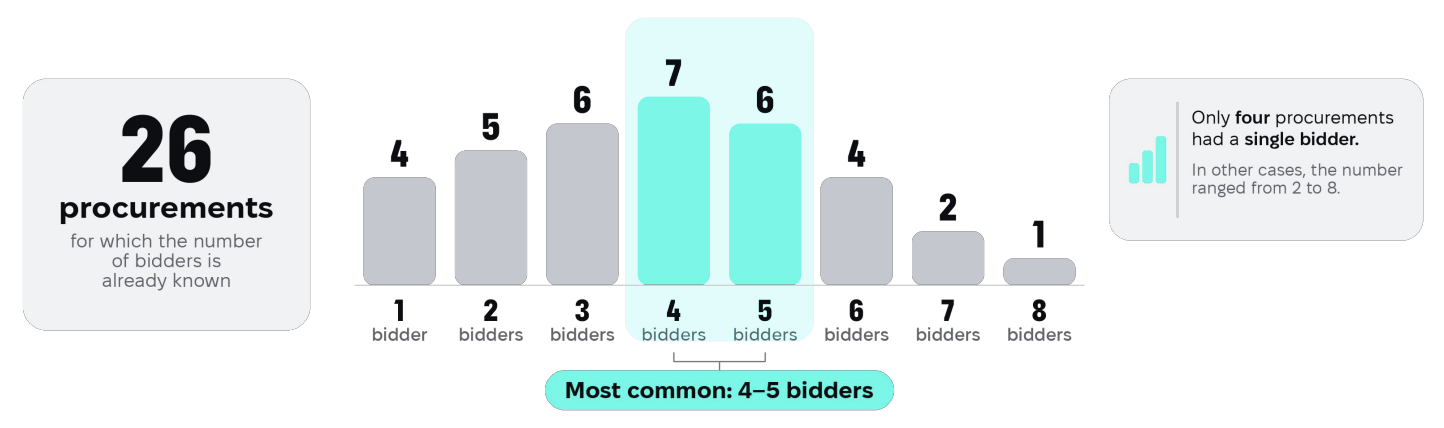
Competition in the tender procedures has been positive. Of the 26 procurements for which the number of bidders is already known, only four had a single bidder. In the other cases, the number ranged from 2 to 8. Most commonly, 4-5 bidders submitted price offers.
The relationship between estimated and actual service costs also warrants attention. Across the 17 procedures that resulted in contracts, the combined estimated value was approximately UAH 3.56 million, whereas the total value of the contracts concluded was approximately UAH 1.04 million, or about 29% of the estimated amount. Substantial savings in public funds are a positive financial outcome, but such significant price reductions in valuation services should subsequently be assessed against the quality of the completed reports and the results of their reviews.
4. Valuation service providers contracted by ARMA
As of 31 August 2026, contracts for the valuation of seized assets had been concluded with five valuation service providers: Sanata Private Enterprise, Standardgroup Private Enterprise, Enter Price LTD Private Enterprise, Trading and Expert Chamber of Ukraine LLC, and Uvecon Consulting Company LLC. Together, they account for 17 concluded contracts.
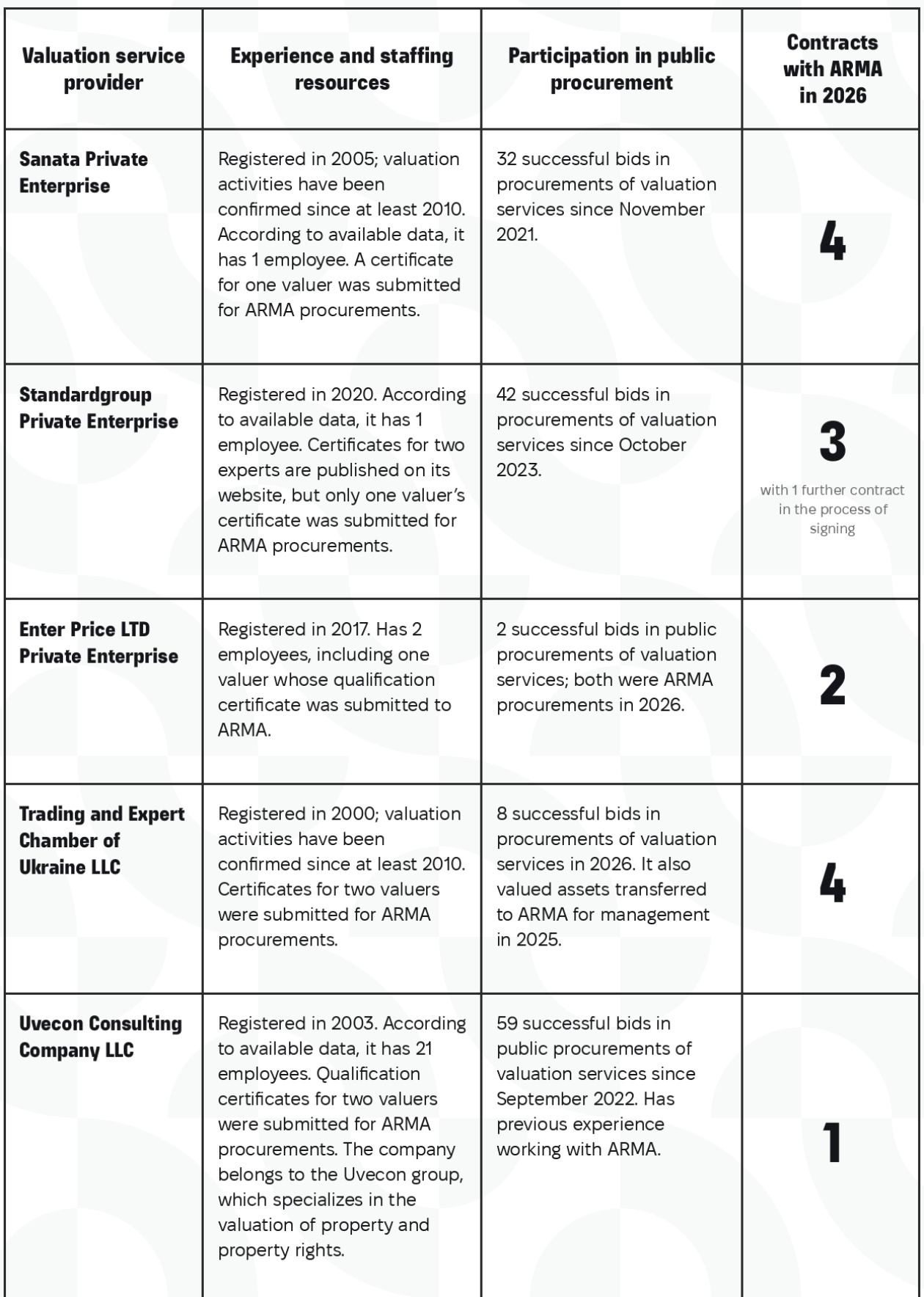
Sanata Private Enterprise has a long operating history and regularly receives orders from central and local government customers. Standardgroup Private Enterprise also has extensive experience participating in public procurement despite its comparatively shorter existence. By contrast, the two contracts with ARMA are effectively the only public procurement wins for valuation services by Enter Price LTD Private Enterprise. Trading and Expert Chamber of Ukraine LLC has been in existence the longest of the five companies and had previously valued assets transferred to ARMA for management. Uvecon Consulting Company LLC has substantially greater staffing resources than the other contractors and long-standing market experience, including work with ARMA.
All five companies hold valuation service provider certificates issued by the State Property Fund of Ukraine. For three of them, real estate agency activities are their principal business activity; for the other valuers, valuation is an ancillary activity. The principal activity of Trading and Expert Chamber of Ukraine LLC is legal services, while that of Uvecon Consulting Company LLC is other professional, scientific and technical activities not elsewhere classified.
Thus, the current pool of contractors is relatively narrow: 17 contracts have been awarded to five valuation service providers, with 10 going to Sanata Private Enterprise and Trading and Expert Chamber of Ukraine LLC. This distribution does not in itself indicate a violation. Nevertheless, given the diversity of assets requiring valuation, it is particularly important to verify each contractor’s actual capacity to provide the necessary specialist expertise for the specific type of asset.
5. Potential areas of concern
1. Absence of a concluded framework agreement
The procurement intended to establish a framework agreement should have created a predefined mechanism for engaging valuers for a pool of assets. As it produced no practical result, ARMA moved to separate procurements for each asset. This may indicate deficiencies in planning valuation procurements or insufficient market readiness to operate under the proposed framework agreement terms.
2. Fragmentation of procedures
Separate procurements make it possible to identify a specific asset, the estimated cost of its valuation, and the status of the procedure. At the same time, numerous small or medium-sized procurements may delay the preparation of assets for management. For ARMA, this entails administering many procedures, monitoring deadlines, checking bidders’ qualifications, and ensuring a consistent approach to asset descriptions.
3. Lack of public traceability of certificates of handover and acceptance of assets by ARMA
The transfer of an asset to ARMA is documented by a handover and acceptance certificate, and the date of its signing marks the starting point for subsequent procedures. In particular, where there is no current valuation, ARMA must initiate one within three business days. However, publicly available information about the procurements reviewed does not systematically indicate the dates on which such certificates were signed. It is therefore impossible to verify when an asset was actually transferred to ARMA, whether it was transferred at all, whether the deadline for initiating a valuation was observed, or how much time elapsed between stages. The absence of a certificate or its details from the public domain does not, however, mean that the asset was not transferred.
4. Varying levels of detail in asset descriptions
In some procurements, assets are described with sufficient specificity, for example by naming the hotel, stating the number of wagons, identifying the vessel, or providing cadastral numbers for land plots. Other procurements, however, have more general titles, with key information contained in annexes or procurement justifications. While this may formally comply with procurement requirements, it makes public oversight more difficult. For effective monitoring, the basic asset description should be clear from the procurement title and short description alone: asset type, quantity, location, court decision, or other grounds for transfer to ARMA.
5. Price as the sole bid evaluation criterion
Procurement justifications for commodity assets state that price accounts for 100% of bid evaluation. Although common in many service procurements, this approach may be insufficient for valuations of complex or specialized assets.
The valuation of vessels, hotel complexes, corporate rights, or large numbers of railway wagons requires specialized experience, access to relevant market data, an understanding of the asset’s legal status, and the ability to account for restrictions arising from seizure, in addition to competitive pricing. If quality requirements are not sufficiently clear, there is a risk of receiving a merely formal report that provides a weak basis for subsequent asset management.
6. Specific characteristics of assets and access to them
For certain commodity assets, services are to be provided remotely. This format may be acceptable if the valuer receives a sufficient set of documents, photographic records, and data on storage conditions, quality, and the actual quantity of the asset. However, for assets whose consumer or marketable characteristics may deteriorate, remote valuation without proper verification can create a risk of inaccuracy.
The risks are even greater for vessels, wagons, hotel properties, and corporate rights. In such cases, the valuation must consider not only the market value of comparable property but also legal restrictions, seizure, technical condition, existing debts or maintenance costs, the feasibility of actual use of the asset, and potential income from management.
7. Insufficient funding for asset valuation and preservation
Only UAH 3 million has been allocated in 2026 for the valuation and preservation of all seized property, which does not reflect actual needs. Funding shortfalls may delay valuations and transfers into management and create risks of asset value loss, particularly for property requiring significant maintenance expenditure or rapidly losing its marketable characteristics.
8. Concentration of contracts among a limited number of valuers
This distribution does not in itself indicate a violation, especially considering that most procurements were competitive. Nevertheless, the concentration of a substantial number of contracts among a small group of contractors requires monitoring, particularly regarding their ability to carry out timely, high-quality valuations of different types of assets simultaneously.
9. Limited staffing capacity of certain valuation service providers
A small number of permanent employees at a valuation service provider does not preclude the engagement of other certified valuers under civil-law contracts. However, where a single provider receives several ARMA assignments simultaneously, it is important to verify not only the formal existence of a qualification certificate but also the team’s actual capacity to complete valuations within the prescribed deadlines and with due regard to the specific characteristics of each asset.
10. Different levels of verified contractor experience
The experience of the five selected providers differs significantly. However, the number of previous procurement awards does not, by itself, establish experience in valuing the particular type of asset assigned to a contractor. This is especially important because ARMA’s procurements cover widely differing assets, from real estate and corporate rights to vessels, railway wagons, and commodities. Qualification requirements should therefore assess the relevance of previous experience to the specific asset type, rather than general valuation experience alone.
Conclusions
The procurements announced in June-August 2026 indicate that, following its reform, ARMA began using public procurement more actively to engage valuers for specific seized assets. This improves procedural transparency because each tender has a separate identifier, an estimated value, and a publicly available status. However, the mere existence of a procurement procedure does not guarantee a high-quality valuation or effective subsequent transfer of the asset into management.
The most significant procedural issue is that the earlier procurement intended to establish a framework agreement for valuing a pool of assets yielded no practical result. ARMA therefore effectively switched to a series of separate procurements. Although this approach may be justified for specialized assets, it requires better systematization, transparent reporting, and consistent asset description standards.
A significant gap in public oversight is the lack of systematic information about the date on which ARMA actually accepted an asset under a handover and acceptance certificate. The statutory three-day period for initiating a valuation runs from this date. Without this information, it is impossible to verify compliance with statutory deadlines or establish a complete timeline of the asset’s transfer from the prosecutor to ARMA and subsequently to the valuer.
The main risk, however, concerns not only the timing of valuations but also their quality. Different types of assets require different approaches: valuing a hotel, vessel, corporate rights, wagons, or agricultural products cannot be reduced to the same technical procedure. A superficial valuation would affect management terms, expected returns, monitoring of value preservation, and the ability to hold an asset manager accountable for ineffective management.
The procurements have effectively resulted in a limited pool of valuation service providers engaged by ARMA to value seized assets. As of 31 August 2026, contracts had been signed with five companies, covering 17 contracts between them. The contractors differ substantially in how long they have operated, their experience in public procurement, and their staffing resources. Given the diversity of assets transferred to ARMA, future procurements should give greater consideration not only to a provider’s formal status and proposed price but also to its actual team, the valuers’ specializations, and verified experience with the relevant asset types.
Recommendations
- Publicly explain the outcome of the framework agreement procurement. In particular, clarify why the framework agreement was not concluded or did not become an operational instrument, whether ARMA intends to relaunch this model, and which terms might be changed.
- Ensure public traceability of ARMA’s actual acceptance of assets. For each asset, at least the date and identifying details of the handover and acceptance certificate should be disclosed. Where possible, the certificate itself should be published with restricted-access information redacted. This would enable verification of the deadlines prescribed by Article 19 of the Law.
- Standardize asset descriptions in procurements. Procurement titles and short descriptions should contain sufficient information for external monitoring without the need to search for essential details only in annexes.
- For complex assets, establish clear qualification requirements for valuers in addition to the formal price criterion. This is particularly important for vessels, corporate rights, hotel complexes, railway rolling stock, and other assets requiring specialized expertise.
- Publish consolidated information on how estimated costs for valuation services are calculated. Where estimated values are based on commercial offers, it is advisable to disclose the number of offers received, the price range, and the methodology used to determine the average or final estimated value.
- Monitor valuation quality in procurements involving substantial price reductions. A significant deviation of the contract price from the estimated value should be accompanied by checks on the completeness of the services delivered and the results of the valuation report review.
- For assets that may rapidly lose value or their marketable characteristics, introduce stronger requirements for verification of their actual condition: photographic records, storage documents, information on quality and storage conditions, and risks of deterioration.
- Verify the actual staffing capacity of valuation service providers. For procurements involving complex assets or substantial volumes of property, it is advisable to consider the number of valuers who will actually be engaged in performing the contract, their qualifications, and the allocation of responsibilities. If valuers who are not employees of the company are engaged, information about them and their qualifications must be available to the contracting authority before the contract begins to be performed.
- After completion of the valuation, ensure a link between its findings and subsequent tenders for transferring assets into management. The terms of asset manager selection procedures should reflect the established asset value, maintenance costs, expected returns, and risks of value loss.