

Shadow Report on the Activities of ARMA
Project “Bridging the Gaps: Monitoring ARMA to Prevent the Withdrawal of Sanctioned and Corruption-Related Assets”
This research was prepared by the Institute of Legislative Ideas with the support of the Organized Crime and Corruption Reporting Project (OCCRP) as part of the project “Bridging the Gaps: Monitoring ARMA to Prevent the Withdrawal of Sanctioned and Corruption-Related Assets.” This material represents the views of the authors and does not necessarily reflect the position of the Organized Crime and Corruption Reporting Project (OCCRP).
Publisher: Analytical Center “Institute of Legislative Ideas.” All rights reserved.
Authors: Alina Bihdan, Tetiana Khutor, Taras Riabchenko, Svitlana Hordiienko.


Analytics content

EXECUTIVE SUMMARY

Overall assessment
An analysis of ARMA’s activities in 2024–2025 indicates that the Agency is undergoing a period of large-scale institutional transformation. The period under review was characterised by the simultaneous reform of the legislative framework, changes to the procedures for managing seized assets, and the Agency’s continued performance of its core functions in the areas of identification, tracing, management, realisation and return of assets.
A key achievement of the period was the establishment of a new regulatory framework for ARMA’s activities, aimed at improving the efficiency of seized asset management. At the same time, most of the legislative changes only came into force in late 2025 – early 2026, which makes it impossible to fully assess their practical effectiveness.
Despite some positive changes, the analysis revealed that a number of systemic problems persist. The most significant of these remains the lack of an end-to-end approach to tracking and assessing the asset lifecycle. The existing reporting system allows for the evaluation of the Agency’s individual functions, but does not provide the means to trace an asset’s path from the moment of its identification to its actual return to the state or the realisation of economic benefits from its management or disposal.
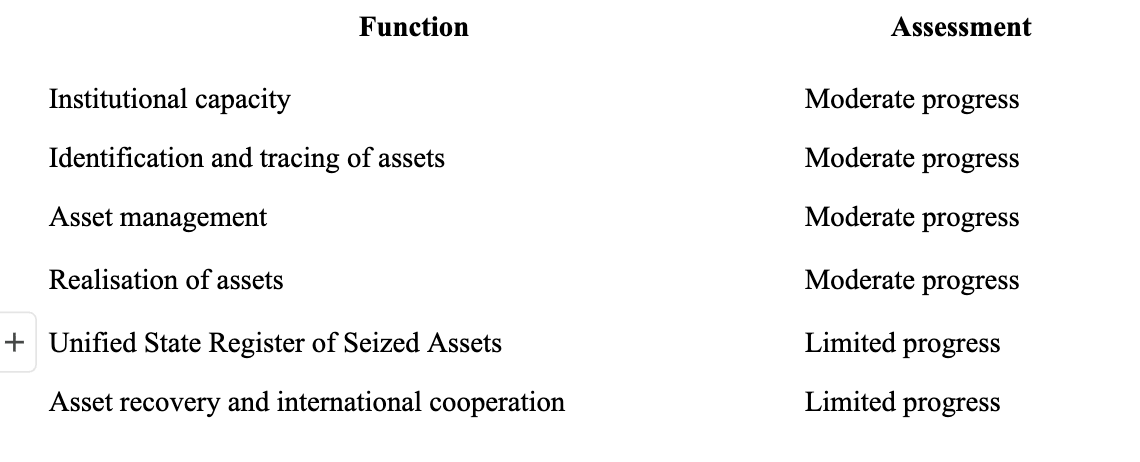
Consequently, ARMA’s overall progress in 2024–2025 can be assessed as moderate: the Agency has demonstrated development in its regulatory and organisational capacity, but most reforms have not yet been accompanied by a sufficient number of verifiable results to assess their effectiveness in practice.
Key findings
- 1. A new operational model for ARMA was established in 2024–2025
Legislative changes have laid the groundwork for a review of approaches to the management of seized assets, introduced new procedures for selecting asset managers, and distinguished between approaches to managing simple and complex assets.
- 2. The asset tracing function demonstrates a high level of activity, but its effectiveness remains difficult to assess
The available reporting does not allow for tracking the subsequent fate of a significant proportion of the identified assets or for assessing their link to subsequent decisions on seizure, management or realisation.
- 3. Legislative reform has not yet been validated by practical results
Despite far-reaching legislative changes and the launch of a new asset management model, most of the new procedures only came into effect towards the end of the period under review; therefore, their actual effectiveness cannot yet be fully assessed.
- 4. The transfer of assets into management continues to be accompanied by significant procedural difficulties
Practice demonstrates the existence of problems with access to assets, lengthy transfer times, interaction with pre-trial investigation authorities, and the preservation of the economic value of assets until management begins.
- 5. The sale of assets generates revenue for the budget, but is characterised by a low proportion of successful auctions
In 2025, the majority of auctions did not result in the sale of assets, and a significant proportion of the procedures were repeat attempts to sell the same lots.
- 6. The Unified State Register of Seized Assets remains an incomplete element of the asset recovery system
Despite the development of digital infrastructure, the Register does not provide comprehensive tracking of the asset lifecycle and is used only to a limited extent as an analytical tool.
- 7. The further development of Ukraine’s asset recovery system will depend on the implementation of European standards
This applies in particular to the implementation of the provisions of Directive (EU) 2024/1260 on the freezing of assets, various forms of confiscation and an integrated approach to asset recovery.
Key recommendations
- Introduce an end-to-end accounting and reporting system covering the full life cycle of assets: from identification and seizure to management, realisation, confiscation and return to the state.
- Conduct a comprehensive assessment of the results of implementing the new asset management model following the completion of its first year of practical application.
- Ensure further harmonisation of Ukrainian legislation with the provisions of Directive (EU) 2024/1260.
- Enhance transparency and accountability in asset management procedures, particularly by introducing public performance indicators for asset managers.
- Ensure the full integration of the Unified State Register of Seized Assets with other state information systems.
- Strengthen the Agency’s human resources and management capacity, including by finalising the establishment of a stable management system.
- Improve inter-Agency coordination between ARMA, law enforcement agencies, the Public Prosecutor’s Office, the courts and the Ministry of Justice.
- Ensure that independent assessments of ARMA’s performance and the implementation of key reforms are carried out on a regular basis.
Key challenge for the next stage of reform
In 2024–2025, ARMA made the most significant progress in terms of legislative changes, institutional development, and the establishment of new procedures. At the same time, most of the problems identified are systemic in nature and relate to the practical implementation of reforms, the insufficient integration of individual functions, and the lack of mechanisms for a comprehensive assessment of the Agency’s performance.
The main challenge for the next stage of development should be the transition from reforming the regulatory framework to ensuring stable, measurable and publicly verified results in the areas of asset management, realisation and recovery.
Introduction
ARMA’s Mandate
The National Agency of Ukraine for Finding, Tracing and Management of Assets Derived from Corruption and Other Crimes (Asset Recovery and Management Agency, ARMA or Agency) is a central executive body with special status, which plays a key role in the system for combating corruption and prosecuting economic crimes. Unlike other bodies, ARMA combines functions covering the full cycle of asset management – from identification to management and/or realisation.
ARMA’s legal status and activities are determined not only by the relevant Law of Ukraine ‘On The National Agency of Ukraine for Finding, Tracing and Management of Assets Derived from Corruption and Other Crimes’ (hereinafter referred to as the Law of Ukraine ‘On ARMA’), but also by a body of regulatory and legal acts governing criminal proceedings, the management of state property, sanctions policy and international legal assistance. This cross-sectoral nature of its mandate necessitates ARMA’s integration into the activities of law enforcement agencies, the judiciary and executive authorities.
ARMA performs the following key functions:
- identifying and tracing assets that may be subject to seizure in criminal proceedings;
- managing seized assets, including transferring them to management with a view to preserving or increasing their economic value;
- realising assets in cases provided for by law;
- maintaining the Unified State Register of Seized Assets;
- facilitating asset recovery, in particular through international cooperation.
In the current climate, ARMA’s role is becoming significantly more important due to the growing volume of seized and sanctioned assets, as well as the need to utilise them effectively in the interests of the state. The Agency’s activities are a key element in Ukraine’s fulfilment of its international obligations regarding asset recovery and integration into the European legal framework.
Furthermore, reform of the system for managing seized assets, including improving ARMA’s effectiveness, has been identified as one of the priorities within international support programmes for Ukraine, in particular the Ukraine Facility, which further underscores the Agency’s particular importance.
Purpose of the report
The purpose of this Report is to conduct an independent and comprehensive assessment of ARMA’s activities in 2024–2025 in terms of their compliance with its statutory mandate, the stated objectives of state policy and international standards in the field of seized asset management.
The Report aims to:
- identify discrepancies between ARMA’s statutory functions and the practice of their implementation;
- assess the effectiveness of key processes relating to the management, realisation and accounting of assets;
- analyse systemic factors affecting the Agency’s performance;
- identifying the risks associated with maintaining existing practices;
- formulate well-founded recommendations aimed at improving regulatory frameworks, institutional capacity and management procedures.
Particular attention is paid to assessing the extent to which ARMA’s activities ensure the achievement of its key objective – the effective management of seized assets whilst preserving or increasing their economic value and adhering to the principles of transparency and accountability.
Scope of the study
This Report covers the period 2024–2025 and focuses on assessing ARMA’s activities in relation to the key functions defined by law, namely:
- identifying and tracing assets;
- management of seized assets;
- the realisation of assets;
- maintaining the Unified State Register of Seized Assets;
- facilitating asset recovery.
At the same time, where necessary to assess the results of reforms introduced during the period under review, the report also takes into account specific regulatory and practical changes that occurred in the first half of 2026. Such references are used solely to assess the state of implementation of new mechanisms and do not alter the main time frame of the study.
The analysis takes into account ARMA’s interaction with other entities, in particular the courts, pre-trial investigation bodies, the public prosecutor’s office, and the executive authorities involved in asset management and realisation processes.
The study examines both the procedures laid down by law and the actual practice of their application, including an analysis of specific cases of asset management and realisation.
The Report focuses on identifying systemic trends, institutional problems and gaps in law enforcement, and is not intended to conduct a full audit of ARMA’s activities or to assess all of the Agency’s individual decisions.
The analysis does not include a detailed examination of:
- all individual asset management cases;
- ARMA’s internal management processes, which are not reflected in publicly available sources;
- issues that fall outside ARMA’s mandate.
At the same time, the report includes an analysis of selected cases and practices that are representative for assessing the overall functioning of the seized assets management system.
Context
ARMA’s activities in 2024–2025 are taking place against a backdrop of full-scale war, a tightening of sanctions policy, and the state’s growing role in managing assets linked to the Russian Federation’s aggression.
The increase in the volume of seized and sanctioned assets, as well as expectations regarding their subsequent confiscation and use for the recovery of Ukraine’s economy, significantly heightens the importance of the effective management of such assets. In this context, ARMA plays a key role as the institution responsible for preserving the economic value of the assets and ensuring the transparency of the relevant processes.
At the same time, ARMA’s activities are the focus of heightened scrutiny from state bodies, international partners, and civil society. This stems both from the need to ensure the effective use of assets and from the risks of a loss in their value, a lack of transparency in procedures and ineffective management. Nor should we overlook the political and public pressure associated with certain assets and their owners.
Ukraine’s integration into the European legal framework and the fulfilment of its international obligations regarding asset recovery lend further significance to this issue. In this context, improving the effectiveness of ARMA’s operations is identified as one of the reform priorities, particularly within the framework of international support programmes for Ukraine.
Thus, the assessment of ARMA’s activities during the period in question has not only institutional but also broader economic and political significance, as it directly affects the effectiveness of public resource management and the level of trust in the anti-corruption infrastructure.
Target audience and stakeholders
Apart from the Agency itself, the Report is aimed at state authorities responsible for anti-corruption policy, law enforcement agencies, the judiciary, executive bodies, as well as international partners and donors.
Key stakeholders include, in particular, the courts, the public prosecution service, the National Anti-Corruption Bureau of Ukraine (NABU), the State Bureau of Investigation (DBR), the Ministry of Justice of Ukraine, the State Property Fund of Ukraine, the Antimonopoly Committee of Ukraine, as well as the business sector and international organisations.
Research methodology and rationale
The assessment of ARMA’s activities in this report is based on a comparative analysis of three key elements:
- the Agency’s statutory mandate;
- ARMA’s official position, in particular its public reporting data;
- the actual practice in carrying out the relevant functions.
This approach makes it possible to identify discrepancies between formally established requirements and the actual practice of their application, as well as to assess the effectiveness of ARMA’s operations in each of the key areas.
The report is structured according to functional principles, in line with ARMA’s main areas of activity. Each analytical section contains:
- a definition of the regulatory standard or expectation;
- a summary of the official position;
- an analysis of actual practice (including statistical data, case studies and case law);
- identified problems and discrepancies;
- an assessment of the risks associated with maintaining existing practices;
- recommendations for addressing them.
In addition, the report employs a triangulation approach, which enhances the reliability of the conclusions and helps to identify discrepancies between official data and actual practice.
This methodological approach ensures a systematic assessment of ARMA’s activities and enables the formulation of well-founded conclusions and recommendations for improving the Agency’s regulatory framework and institutional capacity.
Sources of information
The analysis presented in this Report is based on open and publicly available sources of information covering the regulatory, institutional and practical aspects of ARMA’s activities, in particular:
- Ukrainian legislation governing the activities of ARMA and related institutions;
- official reports, publications and communications from ARMA;
- data from state registers;
- court rulings;
- responses to requests for public information;
- media reports and other open sources.
Particular attention is paid to the analysis of case law and specific asset management cases, which enables an assessment of the actual mechanisms by which ARMA exercises its powers.
The report is not based on access to ARMA’s internal documents and reflects an assessment formed exclusively on the basis of publicly available data. Accordingly, certain aspects of the Agency’s activities may be covered only to a limited extent due to the lack of publicly available information.
ARMA’s institutional capacity in 2024–2025
Institutional mandate and expected operating model
In accordance with the Law of Ukraine ‘On ARMA’, ARMA operates as a central executive body with special status, accountable to the Cabinet of Ministers of Ukraine and authorised to trace, manage and realise assets.
This model involves combining analytical, law enforcement and operational functions within a single institution, which, from the perspective of international practice, is atypical and places heightened demands on internal organisational capacity, the separation of powers and independence from political influence.
International approaches to organising asset recovery systems require clear mechanisms for the separation of powers, internal controls and sufficient human and financial capacity within the bodies responsible for the tracing, management and recovery of assets
The Agency’s official vision for institutional development
In its public reports and communications for 2024, ARMA positions itself as an effective instrument for managing seized assets, emphasising the growth in the volume of assets transferred to its management – measured in tens of billions of hryvnias – as well as in the hundreds of tenders organised to select asset managers.
Organisationally, the Agency comprises a central office and regional offices. Funding is provided from the State Budget, which covers the costs of staff salaries, administrative support and the institution’s operations.
The actual state of institutional capacity in 2024–2025 (resources, organisational and human resources)
ARMA’s actual activities in 2024–2025 reveal a number of systemic constraints on institutional capacity.
The Agency’s organisational structure remains centralised: key decisions on asset management are taken at the level of the central administration, whilst regional offices play a limited role. At the same time, the internal structure does not provide for a clear functional separation between asset tracing and asset management, which runs counter to international approaches to the specialisation of such bodies.
ARMA’s staffing capacity is limited. In 2024 and 2025, the maximum authorised strength of the central office was 300 staff, and that of the regional offices was 90 . However, the actual staffing levels were and remain significantly lower, specifically: in 2024 – 194 (central office) and 51 (regional offices), and in 2025 – 229 (central office) and 73 (regional offices) .
The issue of ARMA’s staffing capacity is not limited to staff numbers alone. A significant proportion of the Agency’s functions requires interdisciplinary expertise, combining knowledge of criminal procedure, anti-corruption legislation, sanctions policy, company law, insolvency, asset valuation, financial analysis, international cooperation and asset recovery mechanisms. In effect, this requires specialists who are equally well-versed in several specialised areas of law and economics.
A separate issue is staff turnover and the difficulty in recruiting specialists, which objectively affect the performance of ARMA’s functions, particularly regarding the management of complex assets. This creates an imbalance given the volume of assets transferred to its management.
The Agency’s funding also does not match the scale of its functions. According to the Law of Ukraine ‘On the State Budget of Ukraine for 2024’, expenditure on ARMA amounted to 189,064.3 thousand UAH, of which 121,382.7 thousand UAH was allocated to staff remuneration. In fact, UAH 148,032 thousand was spent on wages in 2024. In 2025, a special law allocated 539,111.5 thousand UAH to ARMA, of which 201,812.8 thousand UAH was for labour costs (actual expenditure: 229,344.9 thousand UAH).
At the same time, the value of assets under ARMA’s management runs into tens of billions of hryvnias, creating a significant gap between resources and responsibilities.
At the same time, certain functions of ARMA defined by law place an additional burden on the Agency’s budget. In particular, the costs of conducting asset valuations for the subsequent selection of a manager are borne by ARMA. In cases where competitive procedures fail to result in the appointment of a manager or have to be repeated, the associated costs are effectively not reimbursed and are met from budgetary funds. This creates an additional financial risk for the institution in a context of limited funding.
The central administration comprises functional units responsible for asset tracing, asset management, legal support, international cooperation and organisational and administrative functions.
At the same time, regional offices have limited operational autonomy and play a supporting role, which effectively results in a high degree of centralisation in decision-making.
A separate factor is the instability of the leadership.
From June 2023 to 30 July 2025, ARMA was headed by Olena Duma, during whose tenure ARMA significantly transformed its political and public image. However, under her leadership, ARMA was repeatedly the subject of media attention, not least due to the head’s own outspoken stance. During the drafting and adoption of amendments to the Law ‘On ARMA’ (Draft Law No. 12374-d), there were frequent instances of public statements by Members of Parliament regarding ARMA’s activities whilst Olena Duma was in office, and her responses to such statements.
Since 30 July 2025, ARMA has not had an appointed Chair; specifically, on 14 August 2025, the Government appointed Yaroslava Maksymenko as Acting Chair.
Noteworhty, on 18 June 2025, Law No. 4503-IX was adopted, amending the competitive selection procedure for the post of ARMA Chair.
The new selection procedure for the post of Chair of the ARMA involves a fundamental change to the selection model by strengthening the role of international partners. The selection committee now consists of six members, three of whom are appointed by the government on the recommendation of international partners, and no decision can be taken without their support. This significantly reduces the risks of political influence that were characteristic of the previous model, where the committee was composed predominantly of representatives from state bodies.
At the same time, the requirements for candidates have been expanded and the selection criteria have been set out in greater detail. Not only lawyers but also economists are now eligible to participate; proficiency in one of the official languages of the Council of Europe has become a mandatory requirement. For the first time, the law clearly defines the criteria for integrity and professional competence, whilst the requirement for political neutrality has been strengthened – candidates must have had no links with political parties for a period of two years. The procedure has also become more structured: it now includes practical tasks, the possibility of additional tests and a mandatory assessment methodology.
Furthermore, the logic and timing of the competition have been amended. The Commission may submit up to two candidates for consideration by the Cabinet of Ministers, which makes the final decision. The procedure must begin two months before the end of the incumbent chairperson’s term of office (previously 45 days), and in the event of early dismissal, the Commission is formed within 14 days. Taken together, these changes make the competition more formalised, predictable and less vulnerable to political influence.
It is precisely this procedure that must be implemented following the Government’s announcement of the competition for the post of ARMA Chair and the appointment, on 25 September 2025, of the members of the Selection Committee responsible for shortlisting candidates for the post.
However, as of the date of this report, the competition for the post of ARMA Chair has not been completed. According to the Selection Committee, following the testing and assessment stages, only one candidate has actually reached the final stage of the selection process. The practical implementation of the new selection model has also revealed a number of procedural issues relating to the completion of the selection process given the limited number of candidates, which has led to delays in the appointment of the Agency’s permanent head.
On 10 June 2026, the selection committee decided to hold a new competition for the post of ARMA Chair, effectively acknowledging the impossibility of completing the current selection procedure and appointing a head based on its results. Consequently, the process of appointing the Agency’s permanent leadership continues, and ARMA has been operating under the leadership of an acting Chair for over ten months.
As at the date of preparation of this report, the results of the independent audit of ARMA’s activities – which is required under Law No. 4503-IX and is one of the key elements of the Agency’s reform – are also unavailable. The absence of audit results limits the possibility of an objective external assessment of ARMA’s performance and the identification of priority areas for further institutional changes.
In accordance with Law No. 4503-IX, amendments were drafter and adopted to the Regulation on ARMA, the Regulation on the Public Oversight Council of the ARMA; and Procedure for the Formation of the Public Oversight Council of the ARMA (Resolution of the Cabinet of Ministers of Ukraine No. 1539 of 28 November 2025).
Key challenges for institutional development
Despite formal compliance with the law, ARMA’s operational practice reveals a number of systemic gaps between the regulatory model and the actual performance of its functions.
The combination of a wide range of functions within a single body places heightened demands on ARMA’s human, financial and organisational capacity. Given limited resources, this complicates the simultaneous fulfilment of tasks in the areas of asset tracing, management, disposal and international cooperation.
A centralised structure with a limited role for regional bodies reduces the efficiency of asset management. Decision-making is concentrated within the central administration, which causes delays. This is confirmed by cases where the process of transferring assets into management takes a long time, which will be analysed in the following sections.
The Agency’s staffing capacity (390 vacant posts) is inadequate for the scope of its functions and the volume of assets. The shortage of specialists affects not only operational activities but also the Agency’s ability to develop and implement strategic documents, methodologies and new management approaches.
ARMA’s funding is disproportionate to the scale of the assets under management (tens of billions of hryvnias). This limits the ability to supervise asset managers and preserve the value of assets, which has repeatedly been the subject of public debate.
A separate systemic problem remains the incomplete and piecemeal implementation of the regulatory framework governing ARMA’s activities. In 2025–2026, the Agency’s legislative framework underwent significant changes, requiring the adoption of a large number of subordinate legislation to launch new asset management procedures. At the same time, some of the regulatory changes came into force with a delay, and the practical implementation of the new mechanisms has not yet been completed. As a result, the Agency continues to operate under a dual system of old and new procedures, creating additional legal uncertainty for market participants and potential asset managers.
Leadership instability and delays in recruitment processes undermine institutional stability. In 2023, the recruitment process for the head of ARMA was marred by delays and criticism regarding transparency. Currently, the lack of stable leadership and the protracted recruitment process are also hindering the Agency’s operational efficiency and the formation of a professional team within ARMA.
An additional factor contributing to managerial instability is the prolonged absence of appointed deputies to the ARMA Chair following the dismissal of the previous management team. In the absence of a fully formed management team, a significant proportion of strategic and operational decisions are concentrated at the level of the interim leadership, which increases the risks of overburdening, slowing down decision-making processes and the loss of institutional memory. One possible reason for the positions remaining vacant lies in the specific features of the legislative framework, under which the appointment of a new ARMA Chair entails the termination of the powers of the current deputies. However, the effectiveness of a public authority should not depend on the duration of the competition for the position of its head.
It was only on 19 June 2026 – that is, after the commission had announced on 10 June 2026 that the competition for the post of ARMA Chair would have to be re-run – that the Agency announced the appointment of one Deputy Chair of ARMA.
Limited transparency in reporting makes it impossible to assess the effectiveness of asset management. ARMA’s public reports mainly contain aggregated indicators without any details regarding management outcomes. Furthermore, the structure of the indicators and the way they are presented vary from year to year, which complicates the assessment of the Agency’s performance trends and the conduct of independent monitoring of its effectiveness.
A combination of issues relating to delays in the transfer of assets, ambiguous outcomes of competitive procedures, frequent changes to the regulatory framework and instability in the Agency’s leadership creates additional reputational risks for the Agency. This affects not only the level of public trust in ARMA, but also the willingness of potential managers, investors and other market participants to take part in procedures for managing seized assets.
Risks to the Agency’s effectiveness and independence
Maintaining the current model creates risks of inefficient asset management and loss of their economic value, increased political influence over the institution, and corruption due to the concentration of powers. Furthermore, this undermines public and international partners’ trust in ARMA and may negatively affect Ukraine’s fulfilment of its European integration commitments.
Steps needed to strengthen capacity
To improve the institution’s effectiveness, it is advisable to:
- ensure a transparent and timely competitive selection process for appointing the ARMA Chair and limit the practice of acting in an interim capacity for extended periods;
- review the organisational structure, strengthening the role of regional offices;
- align staffing and financial resources with the volume of assets;
- introduce detailed public reporting.
Progress and outstanding issues in the reform
In 2024–2025, there have been some positive developments in ARMA’s procedural activities and communications; however, key institutional problems – in particular, its structure, staffing capacity, transparency and leadership stability – remain unresolved, indicating limited progress in reforming the Agency.
Identification and tracing of assets that may be subject to seizure in criminal proceedings
Legal framework and international guidelines for the function of asset tracing
The Law of Ukraine “On ARMA” defines the identification and tracing of assets as one of the Agency’s core functions. In accordance with Articles 16–18, ARMA must, upon request from pre-trial investigation bodies, the public prosecutor’s office and the courts, take measures to identify and trace assets, ensure international cooperation and provide responses as soon as possible, but no later than within three working days, unless another deadline is specified in the request.
This model involves not merely the accumulation of large datasets on property, but the rapid and procedurally useful identification of assets, which enables them to be subsequently seized and, where there are grounds, transferred into administration.
A similar approach is enshrined in Directive (EU) 2024/1260, which emphasises the early, swift and effective tracing and identification of property as a prerequisite for its subsequent freezing, confiscation or administration.
At the same time, Directive (EU) 2024/1260 significantly expands the operational model of asset recovery authorities compared with ARMA’s current mandate. In particular, it provides for the possibility of the prompt freezing of assets to prevent their disposal or concealment even before the completion of confiscation proceedings. As of 2024–2025, this function is not part of ARMA’s operational model; however, its implementation is envisaged as part of the ongoing alignment of the Ukrainian asset recovery system with EU standards and is being taken into account in the development of the Asset Recovery Strategy for 2026–2030.
Reported results of asset tracing
In its 2024 report, ARMA identifies the function of asset identification and tracing as one of its most effective areas of activity.
In 2024 :
- the total number of assets identified and traced rose from 96,000 to 146,000;
- 5,449 requests from law enforcement agencies were processed;
- the average response time to requests under the ‘three-day’ procedure was 1.97 days;
- the largest number of requests concerned:
- property offences – 1,153;
- crimes against national security – 1,145 .
In connection with these requests, ARMA reports the detection of:
- UAH 8.3 billion, US$79.9 million, €103.7 million;
- 106,470 plots of land;
- 6,372 residential and 5,980 non-residential properties;
- 15,805 vehicles;
- 1,215 railway vehicles;
- corporate rights with a nominal value of 34.04 billion UAH .
In 2025 (according to the ARMA report and official statistics ):
- 5,562 requests were received from law enforcement agencies;
- in addition:
- 3,599 requests from the Ministry of Justice,
- 61 from the National Agency for Corruption Prevention (NACP),
- 246 from foreign authorities.
The summary statistics for 2025 indicate:
- 47,171 properties;
- 20,444 vehicles;
- 36.5 billion UAH, 222.2 million US dollars, 131.2 million euros;
- corporate rights worth 57.5 billion UAH.
Although separate statistics exist for different types of requests, the current reporting structure does not allow asset recovery outcomes to be mapped against their subsequent procedural status. Consequently, it is difficult to evaluate the overall success of the tracing function.
Trends in indicators and changes in reporting approaches
In 2024, ARMA’s statistics are clearly linked to criminal proceedings, which allows for an assessment of the performance of the asset identification and tracing function within its procedural context.
In 2025, the following trends were observed:
- a slight increase in the number of requests from law enforcement agencies (5,449 → 5,562);
- a significant expansion of the range of entities making requests (the Ministry of Justice, the National Agency for Corruption Prevention, foreign authorities);
- the continued breakdown of assets by type (property, vehicles, funds, etc.).
At the same time, the key change lies in the altered logic of data aggregation:
- in 2024 – statistics compiled within the framework of criminal proceedings;
- in 2025 – the results are presented in aggregate form across all areas of ARMA’s activities (criminal proceedings, sanctions tracking, inter-Agency cooperation, etc.).
This means that, despite the availability of comparative tables:
- the figures for 2024 and 2025 are only partially comparable;
- it is impossible to determine what proportion of assets in 2025 was identified specifically through criminal proceedings;
- consequently, it is impossible to assess the dynamics of the tracing function’s effectiveness in its ‘pure’ form (that is, ARMA’s public reporting allows for an assessment of the volume of work carried out (number of requests, individuals, information enquiries and processing times), but contains significantly less information on the subsequent impact of tracing results on the seizure, management or confiscation of assets).
Transparency International Ukraine has also reached a similar conclusion regarding the gap between identified assets and their subsequent fate. In particular, TI Ukraine, analysing ARMA’s report for 2024, noted that out of 12,352 identified properties, only 1,512 were seized, whilst 289 were transferred to ARMA’s management; of the 106,470 identified plots of land, 1,759 were seized and 305 were transferred to ARMA; despite the significant volumes of identified funds, the rates of seizure and subsequent transfer also remained low. According to TI Ukraine’s estimates, on average around 7.8% of identified assets were seized, whilst less than 3% of the total volume of traced property was placed under administration. This does not mean that ARMA is not functioning, but it does mean that the ‘identified’ figure cannot be regarded as a sufficient indicator of effectiveness without analysing the subsequent procedural fate of the asset.
Unlike the 2024 report, the data published by ARMA for 2025 does not allow for determining the total number of assets identified specifically through the asset tracing function in criminal proceedings, nor for tracking their subsequent procedural fate. Consequently, the available public reports do not allow one to trace the relationship between the individual stages of the asset life cycle or to determine what proportion of the traced assets were subsequently seized, transferred to administration, realised or confiscated.
The international component deserves separate attention. The Law of Ukraine “On ARMA” explicitly includes international cooperation among ARMA’s tasks in the field of asset identification and tracing. The 2024 report contains an example of such a search: with the support of foreign competent authorities, as part of Ukrainian criminal proceedings concerning human trafficking and money laundering, 16 bank accounts with balances exceeding 6 million US dollars, 3 properties, 2 vehicles and shares in foreign companies worth over 400 thousand euros were identified. This case demonstrates the potential of international cooperation as a tool for tracing assets abroad.
At the same time, ARMA’s 2025 report does not contain a similar level of detail regarding the results of international cooperation. Although the report contains information on assets identified and traced abroad, it does not allow one to track their subsequent procedural fate, the level of actual recovery, or the economic outcome of international cooperation. This makes it difficult to assess the effectiveness of international activities and their contribution to the overall process of asset recovery.
Do the indicators demonstrate effectiveness?
The main problem with this area of work is that ARMA publicly reports primarily on the volume of assets identified, but much less on their subsequent procedural effectiveness. As a result, the ‘identified’ figure functions as a standalone indicator of success; although ARMA has begun to publish selected figures on the subsequent seizure of traced assets, the available reporting still does not allow for tracking their subsequent movement through the subsequent stages of the asset recovery cycle. This is precisely why large volumes of identified assets do not always translate into tangible anti-corruption or criminal procedural outcomes.
A second systemic problem is the limited comparability of official statistics across years. Although the ARMA report for 2025 contains specific indicators on criminal proceedings, unjustified assets, sanctions mechanisms and international cooperation, changes in the structure and approaches to presenting information compared with 2024 make it difficult to directly compare individual indicators and assess their trends. This is a significant issue in its own right, as the problem lies not only in performance but also in the reporting format, which affects the ability to carry out external oversight and independent analysis of the Agency’s activities.
The third issue is the limited ability to assess the practical outcome of the asset tracing function. Formally, ARMA adheres to the established deadlines: in 2024, responses to ‘three-day’ requests were provided within an average of 1.97 days. At the same time, the indicator of the speed of processing requests does not, in itself, allow for an assessment of the practical value of the results obtained for criminal proceedings. Due to the absence of information in public reports regarding the subsequent use of the search results by pre-trial investigation bodies, the prosecution service and the courts, it remains difficult to assess the contribution of the asset tracing function to achieving the final procedural outcome. Under such circumstances, assessing the effectiveness of this area of activity effectively boils down to analysing the volume of work carried out and the time taken to complete it, rather than evaluating its effectiveness.
The fourth problem is the absence of end-to-end performance indicators in public reporting. ARMA publishes individual indicators regarding the freezing of assets, but does not provide end-to-end tracking of their subsequent movement between the stages of freezing, management, realisation, confiscation and return. As a result, the assessment of the effectiveness of the asset tracing function is effectively replaced by an assessment of the volume of work carried out, which does not allow for an objective determination of the Agency’s contribution to achieving the final outcome.
Consequences of the disconnect between asset tracing and the subsequent fate of assets
If the current approach persists, ARMA will continue to be able to report high figures for ‘identified’ assets without a commensurate real impact on their seizure, preservation and subsequent management. This creates a risk of a misperception regarding the effectiveness of the function among both national authorities and international partners. Furthermore, when data on asset tracing is not linked to data on their seizure and transfer, there is an increased risk that some assets will effectively be lost to the proceedings even before they are seized. This state of affairs runs counter to the very logic of asset recovery, where tracing should not be an end in itself, but rather the first stage in effectively depriving the offender of economic resources.
Furthermore, the lack of preparation for the implementation of the new instruments provided for in Directive (EU) 2024/1260, in particular the mechanisms for the prompt freezing of assets, may complicate the further adaptation of the Ukrainian asset recovery system to the requirements of European Union law and create additional challenges in the process of European integration.
What needs to be changed to assess the effectiveness of the function
In this regard, it is advisable to recommend that ARMA move from reporting on ‘gross’ detection figures to end-to-end statistics covering the entire chain:
identified → seized → transferred to management / realised / confiscated.
Separately, it is necessary to restore and standardise the year-on-year comparability of public data, with a clear breakdown of statistics into at least the following categories:
- criminal proceedings;
- sanctions cases;
- unjustified assets;
- assets of banned parties;
- international requests.
It is also worth supplementing the performance assessment not only with the response time indicator, but also with indicators of subsequent procedural utility: the proportion of assets seized following ARMA’s response, and the proportion of assets transferred to management.
Overall assessment of progress in this area
Moderate progress can be observed in 2024–2025.
On the one hand, ARMA has maintained high volumes of requests from law enforcement agencies and, at least formally, has continued to process them swiftly; in 2025, the number of such requests even increased slightly compared with 2024.
On the other hand, the quality of public reporting has not improved; indeed, in terms of year-on-year comparability, it has actually deteriorated, whilst the data on the low proportion of assets progressing from the ‘identification’ stage to the ‘seizure’ and ‘management’ stages do not provide grounds for suggesting a systematic improvement in the effectiveness of this particular function.
Analysis shows that ARMA’s reporting system in the area of asset identification and tracing remains focused primarily on recording actions taken and the volume of information processed. At the same time, indicators that would allow an assessment of the subsequent fate of identified assets and their impact on the outcomes of criminal proceedings or the asset recovery process remain limited. This creates a situation where a high level of operational activity does not always correlate with the achievement of the final result.
Asset Management
The evolution of the regulatory framework for asset management
The management of seized assets is a core function of ARMA, which is intended to ensure the preservation of the economic value of the asset until the case is resolved on its merits, as well as, where possible, to generate revenue for the state. It is precisely this objective that is enshrined in the Law of Ukraine ‘On ARMA’ following the amendments introduced by Law No. 4503-IX.
In accordance with the legislation, management may be carried out by:
- transferring the asset to a manager selected on a competitive basis;
- the disposal of the asset in cases expressly provided for by law.
In this section, we focus specifically on the transfer of an asset to a manager, which is a key element of asset recovery, designed to transform the seizure of an asset from a formal restriction into a tangible economic outcome.
How did the previous asset management model work (prior to the 2025 amendments)?
Prior to the legislative changes of 2025, the management of seized assets by ARMA was regulated by ARMA’s methodological guidelines, which were approved by internal order , as well as by the general provisions of the Law of Ukraine ‘On ARMA’. However, this was insufficient to establish an effective procedure for selecting managers. In practice, this led to a management model that depended largely on the Agency’s own administrative practices, rather than on a clearly defined legal procedure.
The actual asset management process worked as follows: after an asset was transferred to ARMA’s management, the Agency carried out a basic assessment of the feasibility of transferring it to a third party, after which the process of selecting a manager was initiated. Such selection generally took place in accordance with a procedure that was intended to comply with the requirements of public procurement legislation, utilising elements of market analysis (preliminary market consultations).
At the same time, the absence in the legislation of mandatory stages for the preliminary assessment of an asset, management planning and a clear classification of assets by complexity meant that decisions on the method of management were taken on a case-by-case basis and without any consistency. As a result, the timeframes for transferring assets to management could vary significantly, and the procedure itself depended on the type of asset being transferred, its level of complexity and the availability of interested managers in the market.
Monitoring of management effectiveness was carried out, but it was not systematic in nature and was constrained by both regulatory and institutional factors. This made it difficult to assess whether the key objective – preserving or increasing the economic value of the assets – was being achieved.
Overall, the previous model functioned as a system in which asset management commenced once procedural issues had been resolved, rather than as a proactive process aimed at the rapid and effective integration of the asset into economic circulation.
Consequently, the previous model was characterised by a lack of sufficient procedural detail, limited mechanisms for the preliminary valuation of assets and oversight of management outcomes, which created risks of procedural delays and a loss of the assets’ economic value.
The essence of the new asset management model introduced by Law No. 4503-IX
Law No. 4503-IX introduced a fundamentally different approach to the management of seized assets, replacing the fragmented and reactive model with a more structured system focused on achieving economic results. However, it is worth noting that Articles 21-3, 21-4and 21(-5) of the Law of Ukraine “On ARMA”, which set out the procedures for selecting managers and procuring the relevant services, did not come into force until 30 January 2026.
Whereas previously the management process effectively began with the search for a manager, the new model provides for a step-by-step approach that begins with an analysis of the asset itself. Following the transfer of the asset to ARMA, it is identified and assessed for the feasibility of effective management; on this basis, a preliminary management plan is drawn up, setting out the optimal use of the asset, expected outcomes and key risks.
An important innovation is the classification of assets into simple and complex categories, which enables the application of different manager selection procedures based on their economic and operational characteristics. The selection of a manager becomes more structured, involving preliminary qualification and clearer assessment criteria; where it is not possible to appoint a manager through the main procedure, a fallback mechanism for procuring management services may be used.
The new model places particular emphasis on monitoring the effectiveness of management. The legislation provides for systematic monitoring of the manager’s activities and an assessment of management outcomes, as well as the possibility of changing the chosen model should it prove ineffective.
Thus, asset management is transforming from an administrative procedure into a full-fledged management cycle, encompassing analysis, planning, implementation and control, and aimed at preserving or increasing the economic value of the assets.
To launch this model, the Cabinet of Ministers and other state bodies adopted a number of necessary subordinate legislation between late 2025 and the first half of 2026. In particular, the following acts were approved:
- The procedure and timeframes for the development, approval and amendment of the indicative asset management plan – CMU Resolution No. 1540 of 28 November 2025;
- The procedure for selecting a manager of a simple asset – CMU Resolution No. 166 of 5 February 2026;
- The procedure for selecting a manager of a complex asset – Resolution of the Cabinet of Ministers of Ukraine No. 167 of 5 February 2026;
- The procedure for conducting an auction to appoint a manager of a complex asset (assets) – Resolution of the Cabinet of Ministers of Ukraine No. 167 of 5 February 2026;
- The procedure for conducting an auction to appoint a manager of a simple asset (assets) – Resolution of the Cabinet of Ministers of Ukraine No. 166 of 5 February 2026;
- The procedure for the pre-qualification of participants for the appointment of a manager for a simple asset (assets) using an electronic procurement system – Resolution of the Cabinet of Ministers of Ukraine No. 166 of 5 February 2026;
- Matters relating to the Commission for the Appointment of a Manager of Complex Assets – Resolution of the Cabinet of Ministers of Ukraine No. 138 of 5 February 2026;
- Procedure for monitoring the effectiveness of asset management – Resolution of the Cabinet of Ministers of Ukraine No. 136 of 5 February 2026;
- Procedure for the calculation by the ARMA of the expected value of the subject of procurement of asset (assets) management services – Resolution of the Cabinet of Ministers of Ukraine No. 137 of 5 February 2026.
- On certain issues relating to the transfer by prosecutors and the assumption of management by ARMA of seized assets – Joint Order of ARMA and the Office of the Prosecutor General No. 46/58 of 23 February 2026;
- Procedure for approving the asset manager’s expenses – Resolution of the Cabinet of Ministers of Ukraine No. 256 of 25 February 2026;
- On establishing the minimum sum insured under an asset manager’s liability insurance policy – Resolution of the Cabinet of Ministers of Ukraine No. 257 of 25 February 2026;
- Procedure for the safekeeping of assets taken into management by the ARMA – Resolution of the Cabinet of Ministers of Ukraine No. 433 of 1 April 2026.
- On amendments to the Procedure for the operation of the electronic procurement system and the authorisation of electronic trading platforms – Resolution of the Cabinet of Ministers of Ukraine No. 484 of 10 April 2026;
- On the approval of model asset management agreements – Resolution of the Cabinet of Ministers of Ukraine No. 537 of 30 April 2026;
- On the approval of the Methodology for determining the feasibility of managing an asset (assets) – Resolution of the Cabinet of Ministers of Ukraine No. 710 of 4 June 2026.
At the same time, even after the reform of the legislation, the asset management system continued to operate under conditions where several legal regimes co-existed for different categories of assets. Alongside the new model for the management of seized assets provided for by the Law of Ukraine ‘On ARMA’, a separate regulatory framework continued to apply to assets forfeited to the state or transferred to special management regimes, in particular the Procedure approved by Resolution of the Cabinet of Ministers of Ukraine No. 1233 of 21 November 2023, to which amendments were also made in 2025.
As a result, in practice during 2024–2025, asset management was carried out under at least two different regulatory models: one for assets seized in criminal proceedings and another for assets that, as a result of the application of a sanction in the form of forfeiture to the state, were transferred to state ownership. Such fragmentation of regulation made it difficult to establish a unified approach to asset management and created risks of ambiguous delineation of powers between state bodies in cases where the legal status of an asset changed.
International standards and best practices in the management of seized assets
Modern approaches to the management of seized assets, developed at the level of international organisations – in particular the Stolen Asset Recovery Initiative (StAR), the Financial Action Task Force and within the framework of EU practice – are based on the principle that asset management should not be a mere formality, but a structured and professional process aimed at preserving the economic value of the asset.
The key elements of such a model include: preliminary identification and valuation of the asset prior to making decisions on its use; management planning, including the determination of the optimal model and expected outcomes; classifying assets by complexity, which allows different approaches to be applied to simple and complex assets; engaging professional managers on a competitive basis; and systematic monitoring of management effectiveness with the option to adjust the chosen model.
The legislative changes of 2025 generally reflect the implementation of these approaches in Ukraine. In particular, the Law introduced a mandatory preliminary assessment of assets, along with a draft management plan, the classification of assets into simple and complex categories, structured procedures for the selection of managers, and formalised monitoring of management effectiveness.
Thus, the new asset management model in Ukraine is conceptually in line with international standards; however, its effectiveness depends on the comprehensiveness and quality of the practical implementation of these tools.
Stated outcomes and the official vision for the function
In its reports for 2024–2025, ARMA positions asset management as one of the key areas of its activity and the main source of economic benefit from the seizure of property. The main emphasis is placed on the financial results of management, the number of assets transferred, and the volume of revenue to the State Budget.
According to the 2024 report, the Agency reported revenue of approximately 1.5 billion UAH from asset management, with the total value of cash assets under management exceeding 12 billion UAH, and the implementation of over 300 monitoring measures regarding the activities of asset managers.
In its 2025 report, ARMA declares further growth in key indicators: the conclusion of 38 management contracts via the Prozorro platform and revenue to the budget of over 2.17 billion UAH.
At the same time, quantitative and financial performance indicators predominate in the public reporting. Significantly less attention is paid to assessing the timeframes for transferring assets into management, the actual results of managing specific categories of assets, issues regarding access to assets, and the impact of procedural decisions in criminal proceedings on the effectiveness of management.
Analysis of current practice: the transformation of asset management (2024–2025)
Asset management practice in 2024–2025 was characterised by a shift from a model involving a limited number of actual transfers of assets into management to a more active use of this instrument. At the same time, the changes mainly concerned quantitative indicators and regulatory reform of the system, whilst it is still too early to assess the effectiveness of the new management model.
One of the most telling indicators of these changes was the increase in the number of asset management contracts. Whilst only 7 asset management contracts were concluded in 2024, by the end of 2025, 38 management contracts had already been concluded via the Prozorro system. In addition, under a special procedure, a further 14 contracts were in force in 2025 concerning assets transferred to management on the basis of orders from the Cabinet of Ministers of Ukraine. Thus, during 2025, ARMA significantly expanded the practice of transferring assets to managers and made more active use of the asset management mechanism.
A separate category was formed by so-called strategic assets transferred under a special procedure. These primarily include assets in the energy sector transferred to the management of PJSC ‘UKRNAFTA’, in particular the ‘Hlusko’ petrol station network, the corporate rights of PJSC ‘VK ‘Ukrnaftoburinnya’, LLC ‘Sirius-1’, LLC ‘Sakhalinskoe’ and other assets, as well as the corporate rights of PJSC ‘Lviv Insulator Company’, transferred to PJSC ‘NEC ‘Ukrenergo’. It was this category of assets that subsequently accounted for the bulk of the financial returns from management.
Alongside the increase in the number of contracts, there was also an expansion in the actual practice of transferring assets to managers. An analysis of the timeframes for the actual transfer of assets to managers indicates significant inconsistency in practice during 2024–2025.
In 2024, the average time between the conclusion of a management contract and the signing of the handover certificate was 5 months and 19 days. The shortest transfer period was 151 days (the vessel ‘EMMAKRIS III’), whilst the longest reached 409 days (1 year, 1 month and 13 days) for non-residential premises at 18 Pavlivska Street, Kyiv.
In 2025, the situation improved: the average handover period fell to 27 days, whilst the longest recorded period was 142 days for railway carriages. At the same time, practice remained inconsistent – some assets were handed over almost immediately after the contracts were concluded; in particular, the ‘Zhovtnevy Palace’ complex was handed over the very next day.
Furthermore, as at the end of 2025, certain assets had still not actually been transferred to the managers under handover certificates, despite the management contracts having been concluded. Examples of this include a non-residential building at 71-B Velyka Vasylkivska Street, Kyiv, as well as 1,697 and 51 railway carriages respectively. Practice shows that a prolonged failure to physically transfer assets may also lead to the termination of the management contracts themselves. For instance, the management agreement concerning non-residential premises, motor vehicle parking spaces and machinery storage spaces at 34-A Yevhen Konovalets Street, Kyiv, concluded with TRUB-INZHBUILD LLC in October 2024, was terminated in April 2025 without the assets having actually been transferred to the manager. A similar situation arose regarding the corporate rights of ‘VENTA.LTD’ LLC, where, following the conclusion of the management agreement and a lengthy wait for the necessary approvals, actual management never commenced, and the agreement was terminated in February 2026.
As at the end of 2025, 19 managers were managing assets and asset groups. At the same time, the management structure was characterised by a significant concentration of assets amongst a limited number of entities.
The five largest managers held 24 assets, or around 58.5% of the total number of management agreements. The largest managers were VOEDGER PLUS LLC, UKRNAFTA PJSC, PRIORITET Municipal Enterprise, KOMBINAT PLUS LLC and KAMPARITET Municipal Enterprise. Thus, despite the expansion of the pool of managers, a significant portion of assets remained concentrated amongst a relatively small number of market participants.
In parallel with the increase in the number of contracts, the financial results of asset management have risen significantly. Whilst ARMA reported revenue from asset management of around 1.5 billion UAH for 2024, the total revenue to the State Budget of Ukraine for 2025 amounted to 2.178 billion UAH. At the same time, the estimated amount of guaranteed payments stipulated under the terms of the concluded asset management contracts amounted to just 231,929,527.13 UAH. Thus, actual revenue exceeded the guaranteed payments by almost 1.95 billion UAH. This surplus is primarily attributable to assets in the energy sector that generate revenue exceeding the baseline (guaranteed) obligations set out in the management agreements.
The main source of this financial result in 2025 was the strategic assets of the energy sector. The largest revenues were generated by the corporate rights of PJSC ‘VK ‘Ukrnaftoburinnya’ (UAH 1.82 billion), the ‘Glusko’ petrol station network (UAH 257.8 million) and the corporate rights of Sakhalinske LLC (UAH 56.8 million), managed by PJSC ‘UKRNAFTA’. At the same time, the revenue structure remained extremely uneven: around 98 per cent of all revenue was generated by a limited number of large assets, whilst some assets generated no revenue at all due to delays or the inability to actually commence management. This indicates that ARMA’s financial results are heavily dependent on a few large assets and does not allow for any conclusions to be drawn regarding the effectiveness of the asset management system as a whole.
This indicates that financial results are improving; however, the reason for this is by no means the systemic efficiency of the old management model currently in use, nor the implementation of a new one that has not yet become operational.
The significant increase in the number of manager selection procedures in 2025 warrants separate note. According to ARMA’s data, the number of tenders for the selection of managers increased almost fivefold compared with the previous year. An analysis of data from the Prozorro system confirms this trend: in 2024, 33 tenders for the selection of asset managers were announced (including repeat procedures), whereas in 2025 the figure had risen to 212. This growth indicates a significantly more active use of the mechanism for transferring assets into management and preparations for the transition to the updated asset management model. At the same time, the quantitative increase in competitive procedures does not in itself indicate improved management efficiency, as assessing the results of the new system requires an analysis of the actual transfer of assets, the performance of asset managers and the economic impact of management.
Alongside these quantitative changes, the legislative framework for asset management was reformed in 2025. Law No. 4503-IX introduced new procedures for the transfer of assets into management, as provided for in Articles 21-3, 21-4and 21(-5) ofthe Law of Ukraine “On ARMA”, as well as a differentiated approach to different categories of assets. However, despite these provisions coming into force at the end of January 2026, as of early June 2026 , there is virtually no established practice regarding their application. The tender commission for complex assets only began its work in April–May 2026; therefore, it is currently too early to assess the effectiveness of the new management model.
At the same time, the actual development of new practices for transferring assets into management is proceeding more slowly than envisaged by the reform. As at the date of this Report, there are no completed examples of the transfer of simple assets into management under the new procedures (i.e. individual movable or immovable property). With regard to complex assets, the tender committee has only just begun its work, and the number of tenders announced remains limited. As of 1 June 2026, tenders to appoint managers had been announced for only three complex assets, including the ‘KRYSHTAL’ business centre, the assets of SKN ‘Suchasna Komertsiyna Neruhomist’ LLC, and the corporate rights of the IDS Ukraine group.
In practice, this means that a significant proportion of assets remain outside the new management model, and it is impossible to assess its effectiveness, not only because the legislation is new but also due to the lack of a sufficient number of completed procedures.
Furthermore, it should be borne in mind that one of the key elements of the reform was the need to carry out a full identification of assets already under ARMA’s management. At the same time, according to the Agency’s 2025 public report, the main focus is currently on asset inventory and initial classification. Following the inventory and identification process, 60,274 assets were recorded in ARMA’s management accounts, of which only 20,753 were classified as assets with high management potential. This indicates that the practical implementation of the new model is largely still at the preparatory stage, rather than at the stage of fully launching management procedures.
Overall, asset management practices in 2024–2025 indicate a significant intensification of ARMA’s activities in this area. Whilst in 2024 the key challenge remained the launch of mechanisms for transferring assets into management and the limited number of contracts concluded, in 2025 the focus shifted to issues of financial performance, the actual transfer of assets to managers, the quality of management and the sustainability of the established system. At the same time, the available indicators currently allow us to assess primarily the scale of the Agency’s activities and the financial performance of individual assets, but do not provide sufficient grounds for conclusions regarding the long-term effectiveness of the new legislative model for asset management.
Practical constraints on the transfer of assets to management
Despite the increase in the number of management agreements and financial inflows to the budget, the practice of transferring assets to management continues to reveal a number of systemic problems that affect ARMA’s ability to ensure the preservation and growth of the economic value of seized assets.
- The duration of the process of transferring assets to management and losses in their value
One of the key problems remains the significant time lag between the appointment of a manager and the actual commencement of asset management. Even after the completion of the tender procedure and the conclusion of the contract, the asset may not be transferred to the manager for a long time, creating risks of it lying idle, losing economic value or deteriorating in technical condition. A telling example is the case of the non-residential premises at 18 Pavlivska Street in Kyiv, transferred to the management of the municipal enterprise ‘KAMPariet’, where 409 days (1 year, 1 month and 13 days) elapsed between the signing of the contract and the actual signing of the handover certificate.
- Restricted access to assets and the inability to manage them effectively
The actual transfer of an asset into management does not always mean that it can be effectively managed. In a number of cases, ARMA or the appointed manager face problems with access to the property, a lack of necessary documentation, or a lack of actual control over the asset. One of the best-known examples is the house of the former Minister of Internal Affairs, Vitaliy Zakharchenko, in the centre of Kyiv, to which the Agency’s representatives were unable to gain access for a long time due to the lack of keys. Such situations highlight the gap between the legal transfer of an asset and the ability to actually manage it.
The problem of accessing assets is not limited to isolated technical difficulties and, in some cases, takes on a systemic nature. For instance, whilst attempting to transfer the Trade Union House to ARMA’s management, the Agency faced a de facto blockade of access to the property by organised groups who controlled the premises and obstructed the enforcement of court rulings. Furthermore, the situation was complicated by multiple court rulings ordering the seizure of the asset, which created legal uncertainty regarding its future management. Only after the obstacles had been removed and actual access to the premises secured was the asset transferred to the management of the municipal enterprise ‘KAMPariet’.
Similar problems arose in relation to other economically significant assets. A telling example is the case of the ‘Gulliver’ shopping and entertainment centre, where the process of transferring the asset was accompanied by protracted disputes over control of the property, restrictions on actual access to the premises, and difficulties in determining the future management model. Despite two competitive tendering procedures, no manager was selected for the asset, and the subsequent change in the property’s legal status and the transfer of ownership to state-owned banks effectively halted the process of transferring it to ARMA’s management. These examples demonstrate that, even in the presence of court rulings and formally completed procedures, the Agency is not always able to promptly gain actual control over an asset and ensure its effective management.
- Asset valuations becoming outdated due to lengthy transfer periods
A separate systemic problem remains the dependence of the asset transfer procedure on the validity of their valuation. Under the law, a property valuation report remains valid for six months from the date of its preparation. In cases where the transfer of an asset to management is delayed for a prolonged period, there is a need to carry out a revaluation, as the previous valuation becomes outdated for the purposes of management decision-making and the conduct of competitive tendering procedures. This creates an additional procedural burden and increases the duration of the transfer of assets to management.
The issue takes on particular significance given that certain asset transfer procedures in previous years lasted considerably longer than six months. Under such circumstances, delays may necessitate repeated updates to asset valuations, which, in turn, requires additional financial resources and organisational efforts. At the same time, the funding available for such costs remains limited, creating risks of a further accumulation of assets that are formally under ARMA’s administration but are not, in fact, involved in economic circulation.
- The dependence of management on procedural decisions in criminal proceedings
The effectiveness of asset management depends largely on decisions made by pre-trial investigation bodies and courts, which are beyond ARMA’s control. In cases where seizures are lifted or the procedural status of assets is changed, the competitive procedures that have been carried out may lose their practical significance. A telling example is the case of a property in Lviv, for which a management agreement was concluded with TRANSGOSP LLC; however, following the lifting of the seizure order, the asset was never actually transferred to the manager. Consequently, the selection procedure carried out did not result in the commencement of asset management.
At the same time, practice shows that a change in the procedural status of an asset can affect its management even after it has been physically transferred to the manager. A telling example is the case of one of the assets of the Stereo Plaza concert and entertainment complex in Kyiv. The management agreement for the premises at 119-A Valerii Lobanovskyi Avenue was concluded on 31 October 2025, and just 11 days later the asset was transferred to the manager under a handover certificate. However, following the lifting of the seizure on 25 December 2025, the management agreement was terminated. During the period under management, the asset generated revenue for the state budget amounting to over 950 thousand UAH. This case demonstrates that even the successful management of an asset may be terminated as a result of subsequent procedural decisions that lie beyond the control of ARMA and the manager.
It is also worth noting the piecemeal nature of the transfer of interrelated assets. The effectiveness of asset management can be significantly reduced in cases where interrelated assets are transferred to ARMA through separate procedural decisions and at different times. Under such circumstances, the Agency is forced to organise the management of individual parts of the property complex without being able to simultaneously cover all assets that functionally constitute a single entity.
Examples include specific cases involving the transfer of health resort complexes, where the property was transferred to ARMA gradually and on the basis of different procedural decisions. This approach complicates the valuation of assets, the preparation of competitive tendering procedures, the determination of the optimal management model and the search for potential managers. As a result, an economically coherent asset may be treated as a collection of separate properties, which reduces its investment appeal and potential management efficiency.
- Inadequate quality of individual manager selection procedures
Individual cases highlight the risks of a formalistic approach to setting requirements for potential managers. In particular, during the selection of a manager for the vessel ‘EMMAKRIS III’ and nine other arrested vessels, the initial tender documentation contained limited requirements regarding the experience and specialisation of the prospective manager. Subsequently, the Agency was forced to revise the terms and conditions and repeat the selection procedure. This demonstrates that the improper definition of criteria can delay the start of asset management and reduce the effectiveness of tender procedures.
- Lack of a comprehensive assessment of management performance
ARMA’s public reporting focuses primarily on the volume of revenue generated for the budget, the number of contracts concluded and the number of control measures carried out. At the same time, the Agency does not publish systematic indicators that would allow for an assessment of the effectiveness of the management of individual assets, the extent to which their value has been preserved, the proportion of assets that are effectively idle, or the results of monthly monitoring of managers’ activities. Under these circumstances, even significant financial results do not allow conclusions to be drawn about the effectiveness of the management function as a whole, as the outcomes regarding a significant proportion of the transferred assets remain unknown.
- Lack of sufficient practical experience to assess the new management model
Despite the completion of the legislative reform of asset management, as of June 2026, the new procedures have not yet generated sufficient practical experience to assess their effectiveness. This means that it is currently impossible to draw a well-founded conclusion as to whether the new model is capable of addressing the problems characteristic of the previous approach to transferring assets into management. Key conclusions regarding the reform’s effectiveness can only be drawn once sufficient practical experience with the new procedures has been accumulated and the first comparable results become available.
- Lack of a standardised unit of measurement for assets.
An analysis of ARMA’s reporting indicates the absence of a single approach to defining and accounting for assets as a statistical unit. In different cases, a single asset may be considered to consist of individual corporate rights, consignments of goods, property complexes, individual railway carriages, boxes of goods or other items, which complicates the comparison of indicators relating to the transfer, management and disposal of assets. Under these circumstances, quantitative indicators of ARMA’s performance require cautious interpretation, as they do not always reflect objects that are comparable in economic terms.
Consequences of the incomplete transformation of the system
- Further loss of the economic value of assets. If the timeframes for transferring assets into management remain lengthy, the state will continue to lose potential revenue from their use, and individual assets may lose their market value even before actual management begins.
- Persistence of the gap between legal and actual management of assets. Even after the transfer of assets to ARMA or the appointment of a manager, obstacles to the effective control and operation of the property may remain, thereby reducing the efficiency of the entire management system.
- Low predictability of asset management. The dependence of management on subsequent procedural decisions in criminal proceedings creates risks of disruption to procedures already underway and the loss of the results of tenders that have been held.
- Repetition of the shortcomings of the previous model within the new reform. As the new procedures have not yet undergone a full cycle of practical implementation, there remains a risk that some of the problems of the previous system will be carried over into the new management model.
- Fragmentation of approaches to different categories of assets. The further development of separate procedures for seized, sanctioned and confiscated assets without proper coordination may complicate the formation of a unified and consistent asset management system.
- Limited accountability for management outcomes. If public reporting continues to focus primarily on revenue figures and quantitative indicators, it will remain difficult to assess the actual effectiveness of asset management and the impact of ARMA’s activities on preserving asset value.
- Declining confidence in the asset management reform. In the absence of tangible practical results from the new model, scepticism regarding the effectiveness of the reforms may grow, both among potential asset managers and among international partners.
Priority areas for improving the management system
(1) Complete the harmonisation of legislation in the field of asset management. It is necessary to resolve existing conflicts and inconsistencies between the Law of Ukraine ‘On ARMA’, the Criminal Code of Ukraine and the Code of Criminal Procedure of Ukraine, as well as other regulatory acts affecting the transfer of assets into management and the exercise of the Agency’s relevant powers.
(2) Ensure systematic monitoring of the practical application of the new asset management model. Given that the procedures set out in Articles 21-3, 21-4and 21-5 of the Law of Ukraine “On ARMA” are, in fact, only just beginning to establish a body of case law, it is advisable to introduce regular analysis of the results of their implementation and public reporting on the first cases of assets being transferred to management under the new procedures.
(3) Strengthen cooperation between ARMA, pre-trial investigation bodies, prosecutors and the courts at the stage of transferring assets into management. This will minimise instances where a change in the procedural status of an asset or a lack of necessary information prevents the commencement of actual management following the completion of the competitive procedure.
(4) Strengthen mechanisms for the preliminary preparation of assets prior to their transfer to management. Before competitive procedures commence, it is necessary to ensure the proper identification of assets, verification of their actual condition, accessibility, the completeness of documentation and the existence of any restrictions that may affect subsequent management.
(5) Strictly adhere to the timeframes between the appointment of a manager and the actual transfer of the asset into management. When establishing new practices, particular attention should be paid to the stage of the actual handover of assets, as it is delays at this stage that pose the greatest risks of a loss in the economic value of the assets.
(6) Refine approaches to the selection of managers for complex assets. Qualification requirements must take into account the specific characteristics of particular asset categories and ensure proper verification of the professional capacity of potential managers to manage the relevant assets effectively.
(7) Ensure the development of uniform approaches to the management of different categories of assets. As legislation is further developed, it is advisable to minimise the fragmentation of procedures relating to seized, sanctioned and confiscated assets, ensuring a management model that is as harmonised and predictable as possible.
(8) Introduce an expanded system of public reporting on asset management. Alongside financial results, it is advisable to regularly publish indicators of the time taken to transfer assets into management, the results of monitoring managers’ activities, information on assets that have not actually been transferred into management or do not generate economic returns, as well as indicators of the preservation or increase in the value of assets.
Reform: the gap between regulatory progress and practice
In 2024–2025, significant progress was made at the regulatory level in the field of asset management. Legislative reform created a new model for the management of seized assets, introduced a differentiated approach to different categories of assets, and laid the foundations for a move away from the previous system, which had long been criticised for its excessive procedural complexity and low efficiency.
At the same time, the practical results of the reform are as yet too limited to be properly assessed. As of early June 2026, the new procedures had not yet been applied sufficiently in practice, and most of the systemic issues identified relate specifically to the functioning of the previous management model. It is therefore appropriate to regard the current stage as a transitional one: the regulatory framework of the new system is largely in place, but its actual effectiveness will require further assessment once sufficient practical experience has been gained and the first comparable results become available.
Realisation of seized assets
The regulatory framework for the asset realisation mechanism
The realisation of seized assets within the ARMA system must ensure not only the formal sale of property but also its effective economic use in the interests of the state. In the logic of asset recovery, the sale of an asset is one of the final stages, which must guarantee the preservation or maximisation of its value following seizure.
Currently, the procedure for the realisation of assets is carried out by legal entities selected on a competitive basis; the procedure for selecting such legal entities and the procedure for the realisation of assets are set out in CMU Resolutions No. 558 of 9 August 2017 ‘On the selection, on a competitive basis, of legal entities carrying out the realisation of seized assets’ and No. 719 of 27 September 2017 ‘On the Approval of the Procedure for the Realisation of Seized Assets at Electronic Auctions’ (as amended by Resolution of the Cabinet of Ministers of Ukraine No. 1250 of 14 November 2023).
The sale of assets is carried out via electronic auctions on the Prozorro.Sales platform, which is intended to ensure transparency, competition and market-based pricing. At the same time, the law imposes a number of restrictions, in particular regarding the sale of sanctioned assets and property pending a final court decision, which affects the volume and structure of assets available for sale.
Thus, an effective disposal model requires not only the existence of an electronic auction mechanism, but also the proper preparation of assets, a sufficient level of competition and the minimisation of repeated and unsuccessful procedures.
Public reporting on the results of asset sales
According to ARMA’s 2024 report, the Agency positions the disposal of assets as one of its key areas of work following the launch of the mechanism via Prozorro.Sales.
In its report, the Agency regards the disposal of assets as one of the most effective areas of its work and highlights the growth in revenue to the State Budget, the number of auctions held and the expansion of the practice of disposing of seized assets via the Prozorro.Sales system.
In 2024:
- 165 electronic auctions were held;
- UAH 326.3 million was received by the State Budget, of which UAH 89.7 million was in customs duties;
- 35 meetings of the commission for the selection of organisers were held, 76 tenders were announced, 49 winners were selected and 49 contracts were concluded.
The breakdown of revenue indicates that sales are concentrated in a few categories of assets:
- 33% – potassium chloride (UAH 111.8 million);
- 27% – mineral fertilisers (89.9 million UAH);
- 15% – liquefied gas (50.8 million UAH);
- 25% – other assets.
In 2025, ARMA reports further growth in key indicators:
- 184 auctions were held, of which 41 were successful;
- revenue to the budget totalled 411,470,197 UAH, including 161.9 million UAH in customs duties;
- 4,310 assets out of 5,322 were sold;
- a total of 7,431 assets worth 2.605 billion UAH over the entire period.
Among the largest assets sold were:
- 29,242 tonnes of potassium chloride – 313.3 million UAH;
- the vessel Nika Spirit – 6.5 million UAH;
- ferrous metals (30 wagons) – 23.6 million UAH;
- iron ore pellets (213 railway wagons) – 24.9 million UAH;
- movable property (electronics, clothing, etc.) – 19.1 million UAH.
What does the auction record for 2024–2025 show?
Compared with 2024, ARMA increased the number of auctions held from 165 to 184, whilst budget revenues rose from 326.3 million UAH to 411.5 million UAH. At the same time, the available reporting does not allow for a full comparison of the effectiveness of auction procedures between the two years, as detailed indicators of auction success rates, repeat procedures and the level of competition were only available for 2025. Consequently, the assessment of trends is necessarily based primarily on an analysis of the structure of auctions in 2025.
An analysis of the data for 2025 reveals a more complex picture. According to official figures, only 41 out of 184 auctions (around 22 per cent) were successful. This means that the majority of procedures did not result in the sale of assets or ended without a result.
Our analysis confirms the systemic nature of this problem. Of the 184 auctions, 144 were unsuccessful and 11 were cancelled. At the same time, 84 auctions (around 46 per cent) were repeat procedures for assets that had previously been put up for sale. In fact, this amounts to approximately 100 unique lots, a significant proportion of which were relisted multiple times due to a lack of buyers .
The ratio between the potential and actual sale value is also telling. The total amount received from the sale of the lots was around 196 million UAH, whilst the combined starting value of these assets exceeded 1 billion UAH. This indicates a significant gap between the potential and actual sale value of the assets.
At the same time, ARMA does not carry out a systematic public analysis of the factors influencing the success of asset sales. Practice in 2024–2025 demonstrates significant differences between the sales results for different categories of property: individual consignments of goods, raw materials and movable assets are sold relatively successfully, whilst other lots are put up for sale repeatedly due to a lack of demand. Public reports lack an analysis of how asset characteristics, lot structure, starting price, the condition of the property or the level of market liquidity affect auction results. Under such circumstances, it is difficult to assess whether unsuccessful sales are linked to the specific characteristics of particular assets, shortcomings in their preparation for sale or limited market interest.
At the same time, ARMA’s materials indicate that sales outcomes depend to a large extent on the structure of the sales procedure itself. A significant proportion of auctions do not take place due to a lack of participants; repeat procedures are widely used; and the starting price and lot structure directly influence the final outcome. In the event of failure, the Agency employs price-reduction mechanisms, in particular by conducting English or Dutch auctions .
Thus, the practice of asset sales in 2025 indicates that the system functioned largely through repeat and adapted sales procedures following unsuccessful attempts at disposal, whilst the proportion of successful initial auctions remained relatively low. However, the available data do not allow for a similar assessment of 2024, which significantly limits the ability to compare the system’s effectiveness over time.
Furthermore, a significant proportion of the proceeds is generated by a limited number of large and liquid assets, which further complicates the assessment of the effectiveness of the disposal mechanism in relation to a broader range of seized property.
Systemic barriers to the effective realisation of assets
Despite the increase in the number of auctions and budget revenues, the available data indicate that the system for the realisation of seized assets continues to be characterised by a number of systemic constraints, which prevent its effectiveness from being assessed solely on the basis of financial results or the number of procedures conducted.
- Low success rate of auction procedures
One of the key problems remains the low proportion of successfully concluded auctions. According to ARMA data, in 2025, out of 184 auctions held, only 41 resulted in the sale of an asset, accounting for approximately 22 per cent of the total number of procedures. The remaining 144 auctions either did not result in the sale of assets or were cancelled, indicating a significant gap between the number of procedures initiated and the actual outcome of their conduct. Consequently, the majority of auctions fail to achieve their immediate objective – the sale of assets and the generation of revenue for the budget.
- Recurrence of unsuccessful disposal procedures
The total figure of 184 auctions conducted by ARMA in 2025 does not mean that 184 different assets were put up for sale. The analysis carried out shows that a significant proportion of these procedures resulted from the same assets being put up for sale repeatedly following unsuccessful previous attempts at disposal. In fact, there were 133 competitive procedures and around 100 unique lots, if we exclude repeat auctions for the same properties.
It is particularly telling that 84 auctions, or almost half of all procedures in 2025, were repeat auctions. In many cases, assets were put up for sale a second, third or even more times due to a lack of bidders or the unsuccessful conclusion of previous auctions. This practice indicates that part of the system for the sale of seized assets functions not as a rapid sales mechanism, but as a protracted cycle of repeated procedures.
The repetition of auctions also points to limited initial demand for certain categories of assets. As a result, a sale often becomes possible only after the terms of sale are amended or the starting price is gradually reduced, creating a risk that assets will be sold at a value below their initial economic potential.
- Low level of competition and limited market participation
An analysis of the auctions held indicates limited competition amongst potential buyers. Only 83 bids were submitted for all successful and unsuccessful auctions in 2025. In most cases, a single bidder took part in the auction; less frequently, two.
In certain asset categories, there is a concentration of successful bids amongst a limited group of buyers. In particular, UKRMINCHIM Trading House LLC secured eight successful bids during the sale of potassium chloride consignments. This pattern of participation indicates insufficient competition in the market for seized assets and limits the potential for achieving the maximum market price.
- Inadequate preparation of assets for sale
The practice of selling individual assets shows that the quality of lot preparation directly affects sales outcomes. Such factors include the accuracy of the asset valuation, the completeness of information about the asset, the proper structuring of the lot, and its legal readiness for sale. In some cases, it was precisely problems during the preparatory stage that caused delays in sales or the need to repeat the procedures. This indicates that the effectiveness of a sale depends not only on market demand, but also on the quality of the preparatory work prior to the auction.
- Lack of a systematic analysis of the causes of unsuccessful sales
Despite the significant number of unsuccessful auctions, ARMA does not publish a systematic analysis of the reasons for their failure. The reports lack aggregated data on the impact of the starting price, asset category, lot structure, level of competition or other factors on the results of the auctions. Consequently, it is impossible to determine which specific categories of assets are sold successfully, which face the greatest difficulties, and which management decisions require adjustment.
Individual cases suggest that the reasons for unsuccessful or cancelled sales procedures may be considerably broader than a mere lack of demand for the asset. For instance, during the sale of 494 plots of land in Zakarpattia Oblast, ARMA refused to sign the auction results protocol and conclude the sale and purchase agreement following a verification of the winning bidders. According to the Agency’s official information, the details obtained indicated signs that the winners were linked to the owner of the seized assets. At the same time, such cases are reported mainly in individual news items and do not form part of a systematic analysis of the risks affecting the results of asset sales. Under these circumstances, it is difficult to assess the scale of such situations and their impact on the overall effectiveness of the system for selling seized property.
- Limited ability to assess the system’s effectiveness
Despite more detailed data for 2025, the reporting system still does not allow for a comprehensive assessment of the effectiveness of asset sales over time. The 2024 report contains mainly financial indicators and the number of procedures carried out, but does not provide the means to assess the proportion of successful auctions, the level of competition or the scale of repeat sales. The lack of standardised reporting indicators across years significantly limits the ability to independently assess the development of the asset disposal system and the effectiveness of the reforms implemented.
Furthermore, despite updates to the legislation governing asset management, as at the date of this report, asset sales continue to be conducted predominantly within the procedural framework established prior to the latest ARMA reform. This means that most of the identified issues remain relevant even after the legislative changes have been finalised, and their resolution will depend on the further development of practices in applying the updated legislation.
Long-term consequences of maintaining existing approaches
If current approaches to asset disposal are maintained, there is a risk of a further disconnect between formal performance indicators and the actual effectiveness of the system. An increase in the number of auctions or budget revenues does not in itself guarantee an improvement in the effectiveness of asset disposal, particularly if a significant proportion of these results is generated by a limited range of liquid assets or the repeated use of the same sales procedures.
A separate risk relates to the loss of the economic value of assets due to their prolonged presence in the disposal system. The longer an asset remains unsold and is repeatedly put up for auction, the higher the likelihood of its depreciation, a decline in its market attractiveness, or its sale on terms less favourable to the state.
The persistence of low levels of competition at auctions also creates a risk of limited market-based pricing. In the absence of a sufficient number of participants, the auction mechanism loses one of its key advantages – the ability to determine the maximum market value of an asset through competitive bidding.
Furthermore, the lack of a systematic analysis of the causes of unsuccessful auctions and of standardised performance indicators complicates management decision-making and the adjustment of asset disposal practices. As a result, certain systemic problems may persist over a long period without a proper assessment of their impact on the overall effectiveness of the system.
Key areas for improving the asset disposal mechanism
It would be advisable to expand the system for assessing the effectiveness of asset sales by supplementing financial indicators with metrics that characterise the efficiency of the auction procedures themselves. In particular, public reporting could include information on the proportion of successful auctions, the number of repeat procedures, the level of competition among participants, the ratio between the starting and final sale prices, and the proportion of assets sold at the first attempt.
Particular attention should be paid to preparing assets for sale. The quality of the valuation, the completeness of information about the asset, the proper structuring of lots and the timely removal of legal restrictions directly influence the interest of potential buyers and the results of auctions.
To increase competition in auctions, it is advisable to strengthen communication with the market and ensure more predictable and transparent conditions for participation in auctions. This applies in particular to distressed assets, for which the pool of potential buyers is limited.
It would also be advisable to introduce a regular analysis of the reasons for unsuccessful auctions, followed by the publication of summarised results. This would make it possible to assess the impact of various factors on sales outcomes and to adjust asset sale practices in a timely manner.
To enhance transparency, it would be advisable to report separately on proceeds from asset sales, customs duties, the results of repeat auctions, and the reasons why certain categories of assets remain in the sales system for extended periods.
Overall assessment of the development of the asset disposal system
In 2024–2025, the asset disposal mechanism continued to develop and ensured growth in revenue to the state budget. Disposal via the Prozorro.Sales system became established practice, and the number of auctions held and the volume of funds received showed positive trends.
At the same time, the available data indicate that this quantitative growth was not accompanied by a corresponding improvement in the efficiency of the procedures. A significant proportion of auctions remained unsuccessful, repeat procedures played a substantial role, and the level of competition in many auctions remained limited. Furthermore, the absence of a standardised reporting system between 2024 and 2025 prevents a full assessment of the performance trends of the asset disposal mechanism.
Thus, the development of asset realisation during the period under review can be assessed as moderate. Despite positive financial results and the functioning of the auction mechanism, further improvements in efficiency require not so much an increase in the number of procedures as an improvement in their effectiveness, competitiveness and transparency.
Maintenance of the Unified State Register of Seized Assets
Legal framework and purpose of the Register
The maintenance of the Unified State Register of Assets Seized in Criminal Proceedings (USRAS or Register) is one of the direct functions of ARMA, as provided for by the Law ‘On ARMA’.
Following legislative changes in 2025, the model for the Register’s operation was refined and responsibilities were redistributed among institutions:
- The Ministry of Justice of Ukraine approves the Regulations on the Unified State Register of Assets Seized in Criminal Proceedings and determines the procedure for its operation as a state information and communication system (Order No. 2949/5 of 30 October 2025);
- ARMA is the custodian and administrator of the Register, ensuring its maintenance, data entry, technical operation, information security and public access to the open section;
- pre-trial investigation bodies, the Public Prosecutor’s Office and the courts generate the primary data which forms the basis for entering information into the Register (in particular through court decisions);
- The State Judicial Administration of Ukraine facilitates electronic interaction via the ‘Trembita’ system, which enables court decisions to be automatically transferred to the Register.
At the same time, the current model does not provide for full automated interaction between the Register and all other state registers containing information on immovable property, corporate rights, vehicles, land plots or other categories of assets. Consequently, a significant proportion of the information continues to be entered into the Register through separate administrative procedures and decisions by authorised bodies.
Under the current model, the Register is a state information system which:
- contains details of assets that have been seized in criminal proceedings;
- records subsequent actions relating to the assets (transfer to management, disposal, confiscation, lifting of seizure);
- provides both official access (for law enforcement agencies and ARMA) and, to a limited extent, public access to the data.
In view of this, an effective Register must fulfil not only a record-keeping function but also the function of end-to-end tracking of an asset’s life cycle:
seizure → transfer to management → appointment of a manager / disposal → financial outcome → lifting of seizure / confiscation
To fulfil these tasks, the Register must:
- cover all relevant assets;
- be updated in a timely manner;
- record data in accordance with an agreed methodology;
- enable the extraction of key indicators;
- ensure public oversight within the limits defined by law.
It is precisely this model that aligns with the EU’s approaches to asset tracing and management systems, where asset registers serve as a fundamental tool both for day-to-day operations and for accountability and the assessment of the effectiveness of public policy in the field of asset recovery.
How ARMA assesses the development of the Register
In its 2024 report, ARMA emphasises that the Register forms part of the Agency’s digital infrastructure and that, in 2024, electronic copies of court decisions that had entered into force – concerning the seizure or lifting of seizure, the transfer of assets into administration, confiscation/special confiscation and the forfeiture of assets to the state. This interaction is carried out with the State Judicial Administration via the ‘Trembita’ system. Separately, ARMA reports that, to ensure uninterrupted data storage, a contract was concluded in 2024 for a cloud service to back up the Register’s infrastructure and to host a duplicate IT infrastructure in a backup data centre.
In the same report, ARMA notes that the operational launch of the Register was introduced by Order No. 18 of 30 January 2023, meanwhile public access to the Register’s data was restored in August 2023. ARMA explicitly links the launch of the Register to open data policy and European ARO/AMO practice .
In 2025, ARMA’s annual report already uses data from the Register as the primary source of statistics on seized assets.
According to the report, as at the reporting period, the Register recorded, in total, 20,635 residential and non-residential properties and construction projects under development, 184 property complexes, 27,727 plots of land, 65,504 motor vehicles, 457 units of air, sea and river transport, 3,954 units of rail transport, 9,477 tractors, agricultural machinery and trailers, 9,832 motorbikes, bicycles and scooters, 10,786 bank accounts, 7,367 corporate rights, 559 property rights, 252,067 items of movable property and 8,597 items of agricultural produce, natural resources and materials.
Specifically for 2025, the Register shows an increase by category: 6,211 residential and non-residential properties, 9,599 plots of land, 21,592 motor vehicles, 2,317 bank accounts, 477 corporate rights, 48,342 items of movable property and 1,500 items of agricultural produce, natural resources and materials .
At the same time, ARMA’s own report for 2025 explicitly notes the limitations of the Register’s technical capabilities: the Register does not provide for the automatic calculation of the number of assets for which the seizure was lifted during the reporting period, nor does it provide an automatic calculation of the total amount of funds seized during the reporting period. This is one of the most significant public indications that, even after modernisation, the Register still does not provide comprehensive analytics on key indicators.
Transformation of the Register in 2024–2025
In 2024–2025, tangible institutional development of the Register can be observed.
In 2024, ARMA ensured the daily automatic upload of court decisions to the Register and the provision of infrastructure through a cloud service, and in October 2024, the Register was recognised as a critical infrastructure facility.
From January 2025, ARMA launched a major update to the Register’s interface and functionality, and in its 2025 report it explicitly states that throughout the year its stable operation, cyber security and round-the-clock user access without disruptions were ensured .
Furthermore, according to public statements by ARMA, in the spring of 2024 the Register contained over 244,000 records of seized assets, of which 68,500 had been transferred to ARMA for management, whilst in the autumn of 2024 the Agency had already reported over 324,000 entries and 72,000 assets under its management. These figures demonstrate the rapid expansion of the database and indicate that the Register has become a system that is actually used, rather than a mere formality.
In the public domain, there are also variations in the methodology used to record assets in the Unified State Register of Seized Assets. While in 2024 ARMA reported over 244,000 entries in the Register, and later reported over 324,000 entries, the results of an inventory conducted as of December 31, 2025, showed that the Agency only had 102,569 entries on record. During the review of these results at a meeting of the Parliamentary Committee on Anti-Corruption Policy, ARMA representatives attributed this discrepancy to the inventory process, a revision of the accounting methodology, and the exclusion from calculations of a significant number of assets that lack independent economic value. At the same time, the discussion itself revealed that the issue of a unified methodology for asset accounting and the consistency of the Registry’s statistical indicators remained unresolved.
At the same time, the change in the number of entries alone does not allow for an assessment of the Register’s effectiveness as an asset management tool. Even after modernisation, the system continues to primarily reflect the existence of individual assets or procedural decisions concerning them, but does not provide comprehensive tracking of their subsequent movements within the cycle of seizure, management, realisation and release from seizure.
A significant step in 2025 was the regulatory update to the model for maintaining the Register. The new Regulation of the Ministry of Justice dated 30 October 2025 replaced the previous ARMA Regulation of 2020.
According to some estimates, the new regulation has significantly expanded the scope of information regarding asset management: whereas the previous model recorded only proceeds from management and disposal, the new one requires the recording of the results of the appointment of a manager, the key terms of the contract including the amount of remuneration, a reference to the contract itself, monthly income from management, reimbursement of expenses, the results of performance monitoring, as well as the separate recording of asset pools. For the disposal of assets, references to electronic auctions and the asset valuation are now also recorded. At the same time, the deadline for submitting information has been reduced from seven working days to the next working day following receipt of the information from authorised entities.
Why has the Register not yet become a fully-fledged asset recovery tool?
Despite obvious progress in digitalisation, the main problem with the Register lies not in the fact of its existence, but in the fact that its analytical and monitoring value remains limited. This is most clearly illustrated by a note from ARMA itself in its 2025 report: the Register’s technical capabilities do not allow for the automatic calculation of how many assets were released from seizure during the year, nor do they allow for the automatic determination of the total amount of seized funds for the reporting period . This is a fundamental issue, as without this data the Register does not provide a complete picture of the ‘movement’ of assets, statistical data may be subject to manipulation, and ARMA’s human resources will continue to be spent on compiling reports and statistics.
A second systemic problem remains the lack of full integration of the Register with other state information systems. Despite court decisions being automatically fed into the system via ‘Trembita’, there is no publicly available information regarding similar automated interaction with most state registers containing details of property, corporate rights, vehicles or land plots. This increases reliance on manual data entry and updating and creates risks of data inconsistencies.
A third problem is the lack of comprehensive end-to-end tracking of an asset’s lifecycle. Despite the expansion of the list of details in 2025, the Register still does not allow for easy tracking of an asset’s path from the moment of seizure to its transfer to management, sale, confiscation or the lifting of the seizure. As a result, the Register remains primarily a tool for recording individual events, rather than a system for monitoring the entire asset recovery cycle.
The fourth problem is the lack of a consistent and transparent methodology for recording assets in the Registry. ARMA’s public announcements over the years have contained significantly different figures regarding the number of entries in the Unified State Registry of Seized Assets.
The fifth problem is the Register’s limited public utility for external monitoring. Since the Register was launched, members of the public have repeatedly pointed out that, for proper public oversight and for potential administrators, it is not only general data on seizures that is important, but also information such as the location of the asset, convenient links to calls for tenders for administrators or auctions on Prozorro.Sales, as well as the Register’s ability to generate reliable and consistent statistics. In 2024–2025, ARMA partially addressed these comments by adding links to administrator selection processes, auctions and other new fields; however, the criticism regarding the Register’s suitability for monitoring has not been fully resolved, as the public section still does not reflect the entire life cycle of an asset in an analytically convenient format .
As a result, the Register does not yet provide the ability to link the results of asset tracing, management and realisation functions, which limits its role as a central tool for coordinating the entire asset recovery system.
Consequences of maintaining the existing limitations
If the current approach persists, the Register risks remaining a powerful tool for operational accounting, but failing to evolve into a fully-fledged tool for analytics, accountability and external oversight.
Under such a model, ARMA will be able to showcase large volumes of records and technical improvements to the system, but users will continue to have limited ability to answer basic questions: what volume of assets is actually liquid; what proportion of assets has been released from seizure; which assets have actually been transferred for management or disposal; and what financial outcome is associated with specific entries in the Register. This gap between ‘the existence of the Register’ and ‘the quality of data for management and control decisions’ is a key risk.
A separate risk lies in the possibility that the Register will never become a fully-fledged tool for supporting management decisions. In the absence of end-to-end tracking of the asset lifecycle and integration with other state systems, it will remain primarily a database for asset accounting, rather than a tool for analysing the effectiveness of asset recovery policy.
A further risk is the lack of trust in the data. The designation of the Register as a critical infrastructure asset and its cyber-hardening in 2024–2025 have enhanced the system’s security, but issues of data consistency, completeness and methodological uniformity remain no less important than cybersecurity. For an asset recovery system, a secure but methodologically ‘cluttered’ or incomplete register poses just as many problems for decision-making.
Steps towards creating a fully-fledged asset accounting system
For this sub-point, it is advisable to recommend that ARMA and the Ministry of Justice complete the transition from a ‘register of records’ to an ‘asset lifecycle register’.
First and foremost, the public and administrative sections of the Register must ensure end-to-end tracking of asset movements:
seizure → transfer to management → appointment of an administrator / disposal → receipt / lifting of seizure / confiscation.
This very logic is already partially enshrined in the new 2025 Regulations, but it needs to be brought to full practical implementation.
Separately, it is worth recommending:
- 1 – to remove the technical limitations acknowledged by ARMA itself in its 2025 report, in particular regarding the automatic calculation of lifted seizures and the amount of seized funds;
- 2 – ensure that the Register has a legally regulated electronic data exchange with key state registers;
- 3 – introduce mechanisms for fully tracking the life cycle of an asset from the moment of seizure until its final removal from the asset recovery system;
- 4 – standardise the methodology for calculating assets, asset pools and entries in the Register to ensure that year-on-year statistics are comparable;
- 5 – provide regular public explanations of major changes in the dataset relating to the inventory or ‘cleansing’ of the Register. This will reduce the risk of mistrust in the figures and enhance the analytical value of the Register for external users.
The Register: Between Digital Progress and Functional Limitations
In 2024–2025, the regulatory and organisational framework governing the operation of the Unified State Register of Seized Assets was further developed. ARMA ensured electronic interaction with the Unified State Register of Court Decisions, implemented measures to ensure the continuity of operations and the redundancy of the Register’s infrastructure, and updated the regulatory framework for its maintenance, expanding the scope of data and reducing the timeframes for its entry.
At the same time, a qualitative breakthrough in the Register’s development remains limited for the time being. Despite some positive changes in regulatory frameworks and the digitalisation of processes, the Register continues to fulfil primarily an asset-recording function. Its transformation into a fully-fledged tool for management, analytics and control over the asset lifecycle remains incomplete.
Given the scale of the planned integrations with other state information systems, the development of analytical functionality and the automation of data exchange, the further modernisation of the Register will require not only regulatory changes but also adequate financial and technical support, in particular through the involvement of international technical assistance.
Facilitating asset recovery, particularly within the framework of international cooperation
International standards and the expected model for asset recovery
Asset recovery is a complex function encompassing the identification, seizure, confiscation and repatriation of assets obtained through criminal means, particularly from foreign jurisdictions. In international law, this approach is enshrined, in particular, in Chapter V of the United Nations Convention against Corruption, which defines asset recovery as one of the key principles of global anti-corruption policy.
In Ukraine, the function of asset recovery is carried out through the cooperation of several state bodies, which oversee the various stages of the process – from the identification of assets to their confiscation and actual return. Within this system, ARMA plays a specialised role, in particular:
- identifying and tracing assets, including those abroad;
- ensuring international cooperation with competent foreign authorities;
- participates in the processes leading up to the confiscation and return of assets.
ARMA’s international cooperation is based on the standards of the Asset Recovery Offices (ARO) network, as well as on key international instruments:
- the United Nations Convention against Corruption;
- the Council of Europe Convention on Laundering, Search, Seizure and Confiscation of the Proceeds from Crime and on the Financing of Terrorism;
- FATF standards;
- EU Directive 2024/1260.
Directive (EU) No 2024/1260 is of particular significance for the development of the asset recovery system, as it significantly broadens the approach to asset recovery in EU Member States. Unlike the previous model, the Directive covers not only the tracing of assets but also mechanisms for their freezing, management, confiscation and subsequent return. It also provides for the use of various forms of confiscation, including extended confiscation, confiscation without a conviction, value-based confiscation and confiscation of unjustified assets. For Ukraine, this means the need to further develop its legislation and institutional framework for asset recovery in line with European requirements.
The asset recovery strategy adopted in Ukraine provides for:
- coordination between authorities;
- the development of international cooperation;
- improving the efficiency of asset recovery from abroad;
- regular reporting on the results.
In this context, an effective asset recovery system must ensure not only the identification of assets, but also their actual recovery or confiscation.
How ARMA presents the results of its international activities
In ARMA’s reports for 2024–2025, the international component and asset recovery are presented as an important but secondary area of activity.
In 2024, ARMA reported specific results of international asset tracing, in particular:
- 16 bank accounts abroad were identified with a balance of over US$6 million;
- 3 properties;
- 2 vehicles;
- shares in foreign companies worth over 400,000 euros .
These cases demonstrate ARMA’s ability to work with foreign jurisdictions and obtain information on assets.
In 2025:
- 246 requests from foreign authorities were recorded;
- at the same time, ARMA continues to process requests from Ukrainian authorities regarding assets abroad .
At the same time, the report lacks a separate section on the recovery of assets as a result, and no aggregated data has been provided on:
- confiscation abroad;
- the repatriation of assets;
- the financial impact of such actions.
From international asset tracing to asset recovery: lessons from 2024–2025
Formally, Ukraine has established an institutional framework for asset recovery that is in line with international approaches. ARMA acts as the national Asset Recovery Office (ARO) – the institution responsible in EU Member States for detecting and identifying assets linked to criminal activity.
In 2024–2025, this system demonstrated stable operation in terms of:
- processing enquiries;
- asset tracing, including abroad;
- cooperation with foreign jurisdictions.
In particular, in 2024, ARMA reported specific results from international investigations: 16 bank accounts with balances exceeding US$6 million, 3 properties, 2 vehicles and corporate rights worth over €400,000 were identified.
In 2025, 246 requests were recorded from foreign authorities, indicating Ukraine’s active participation in the international exchange of information.
However, even with these figures, the key problem is that ARMA’s activities are concentrated at the asset identification stage, whilst the subsequent stages – confiscation and recovery – remain significantly less developed.
In other words, the system functions primarily as a tracing tool (for the detection and identification of assets), but not as a fully-fledged recovery mechanism (for the return of assets to the state).
At the same time, the subsequent stages of asset confiscation and recovery depend on the powers of other state bodies, court rulings and international legal procedures. Consequently, ARMA is involved only in certain stages of the process and does not have sufficient tools to ensure the completion of the full asset recovery cycle.
This is due to several factors:
- the lack of systematic public statistics on the confiscation and recovery of assets;
- the complexity of legal procedures at subsequent stages;
- dependence on the decisions of foreign courts and their assessment of the need to return an asset ;
- insufficient integration between the stages (investigation → seizure → confiscation)
At the same time, public reporting does not contain information that would allow one to trace the full path of an asset from the moment of its detection to its actual return to the state. This makes it impossible to assess the effectiveness of the asset recovery system as a single process and does not allow one to determine what proportion of detected assets reaches the stage of confiscation and subsequent recovery.
Thus, despite a formal increase in international activity, the effectiveness of the system cannot be assessed on the basis of detection figures, as these do not translate into the final outcome – the return of assets.
Opportunities and limitations of international cooperation
International cooperation is a key element of the asset recovery system, as a significant proportion of assets linked to corruption and economic crimes are located outside Ukraine.
ARMA carries out such cooperation through several institutional and technical mechanisms:
The ARO (Asset Recovery Offices) network – a system of national authorities from EU Member States that exchange information on assets. Within this network, ARMA acts as the Ukrainian contact point.
The SIENA (Secure Information Exchange Network Application) system is used – a secure platform administered by Europol that facilitates the rapid exchange of information between law enforcement agencies in different countries.
At the same time, modern European approaches to asset recovery are gradually moving beyond the mere exchange of information. Directive (EU) 2024/1260 provides for a strengthened role for asset recovery authorities, the development of asset freezing mechanisms, and closer links between the stages of tracing, confiscation and return. This sets new benchmarks for the further development of the Ukrainian system.
Cooperation takes place through:
- bilateral requests;
- participation in international investigations;
- cooperation with the judicial authorities of other states.
From a practical point of view, this cooperation makes it possible to establish the existence of assets abroad, obtain information on bank accounts, property and corporate rights, and confirm links between assets and individuals.
However, whilst ARMA can successfully establish the existence of an asset abroad, it has no control over the freezing of that asset in another jurisdiction, its confiscation, or its return to Ukraine.
In other words, ARMA’s involvement in the current model of international cooperation is largely limited to the exchange of information, rather than the full cycle of asset recovery.
As noted in the Report on the results of the external independent evaluation (audit) of NABU’s effectiveness, covering the period up to 2024, one of the key reasons for the non-recovery of assets is that foreign courts do not establish a sufficient link between the asset and the offence. Clearly, this is the responsibility of law enforcement agencies and the courts, whilst ARMA has no powers to deal with the asset at this stage of the process.
This means that even where information about an asset is available, its confiscation depends on the quality of the evidence, compliance with foreign standards and the conclusion of criminal proceedings in Ukraine.
Thus, ARMA’s international cooperation is a necessary but insufficient condition for asset recovery.
Why the system does not yet provide a full asset recovery cycle
Despite the expansion of international cooperation and the increase in the number of international requests, the asset recovery system in Ukraine remains underdeveloped as a fully-fledged mechanism for asset recovery. An analysis of ARMA’s activities in 2024–2025 shows that the key constraints relate not only to the Agency’s institutional capacity but also to the overall architecture of the asset recovery system.
One of the main problems remains the lack of measurable results regarding the actual recovery of assets. ARMA’s public reports contain information on the number of international requests, areas of cooperation and specific examples of identified assets; however, they do not allow for an assessment of the volume of assets that have actually been returned to Ukraine or recovered as state revenue as a result of international cooperation. As a result, the assessment of the Agency’s activities is based primarily on process indicators rather than on the final outcome.
At the same time, the current legislative and institutional framework limits ARMA’s ability to influence the final stages of asset recovery. Once assets have been identified, the further progress of the case depends on the actions of pre-trial investigation bodies, the prosecution service, court rulings and international legal assistance procedures. Thus, the Agency remains one of the participants in the process but does not control the full cycle of asset recovery. An additional challenge is the need for further harmonisation of Ukrainian legislation with the approaches set out in Directive (EU) 2024/1260, in particular regarding the development of asset freezing mechanisms and various forms of confiscation.
Another issue is that international activities are concentrated primarily at the asset tracing stage. The available results indicate progress in international information exchange and tracing functions; however, considerably less attention is paid to the subsequent stages of asset confiscation and recovery. As a result, the international component of the system is largely geared towards locating assets, whilst the effectiveness of their actual recovery remains uncertain.
A separate problem remains the lack of end-to-end tracking of the full asset recovery cycle. The current reporting does not allow the path of an asset to be traced from the moment of its identification abroad through to its seizure, confiscation and actual return. Consequently, it is impossible to assess what proportion of international cases results in the actual return of assets, or to identify the stages at which the system loses the greatest number of potential outcomes.
Furthermore, the effectiveness of international asset recovery depends to a large extent on the decisions of foreign jurisdictions and the duration of international proceedings. Even after assets have been successfully identified, subsequent processes can drag on for years and lie beyond the direct influence of the Ukrainian authorities. This creates additional risks of delays in proceedings, loss of assets or the inability to actually recover them despite a successful tracing phase.
What will happen without further changes
In the absence of significant changes, the asset recovery system risks remaining primarily a system for the international tracing of assets rather than their actual return. In such a model, the main resources are directed towards asset tracing and the international exchange of information, whilst the subsequent stages of confiscation and return remain underdeveloped and are largely dependent on external factors.
The lack of end-to-end tracking of asset movements between the stages of tracing, seizure, confiscation and return creates a risk of losing results at individual stages of the process. Under such conditions, even the successful identification of assets does not guarantee their subsequent return, and the effectiveness of the entire system remains difficult to assess.
A separate risk relates to the limited evidential value of evidence in international cases. Where the materials of criminal proceedings do not meet the requirements of foreign jurisdictions or do not allow the origin of the assets and their link to the offence to be properly substantiated, the likelihood of successful confiscation and recovery is significantly reduced.
A further challenge remains Ukraine’s gradual alignment with European standards on asset recovery. In the absence of further adaptation of legislation to the requirements of Directive (EU) 2024/1260, a gap may persist between the European model of asset recovery and the actual capabilities of the Ukrainian system, particularly regarding the application of asset freezing mechanisms and various forms of confiscation.
Consequently, there is a risk of a situation arising where a high level of international activity and a significant number of identified assets are not accompanied by commensurate results in the form of assets that have been confiscated and actually returned to the state.
Priorities for the development of the asset recovery system
A key priority for the development of the asset recovery system should be the establishment of an end-to-end mechanism for recording results at all stages of the process – from the identification of assets to their actual return to the state. Public reporting should make it possible to track the movement of assets between the stages of tracing, seizure, confiscation and return, as well as to assess the financial outcome of completed cases.
A separate area of reform should be the further harmonisation of Ukrainian legislation with the provisions of Directive (EU) 2024/1260. This concerns both the development of asset freezing mechanisms and the improvement of the legal framework governing various forms of confiscation, including extended confiscation, confiscation without a conviction, value-based confiscation and the confiscation of unjustified assets.
Improving the quality of financial investigations and the evidential basis in international cases remains a key priority. The effectiveness of asset recovery procedures depends to a large extent on the ability of Ukrainian authorities to ensure that the origin of assets, their link to the offence and the compliance of the evidence with the requirements of foreign jurisdictions are properly documented.
At the same time, it is advisable to develop international cooperation not merely as a mechanism for exchanging information, but as a tool for achieving the ultimate outcome. This entails involving foreign partners at an earlier stage in investigations, utilising joint investigation teams and making more active use of international asset recovery mechanisms.
It is also advisable to strengthen inter-Agency coordination between ARMA, pre-trial investigation bodies, the Public Prosecutor’s Office, the Ministry of Justice and other entities within the asset recovery system. Only by functioning as a single procedural chain will these bodies be able to ensure the transition from the successful identification of assets to their actual recovery.
Between institutional development and a lack of proven results
In 2024–2025, Ukraine maintained and developed the institutional framework for international cooperation in the field of asset recovery. ARMA continued to fulfil the functions of a national asset tracing office, maintained cooperation with foreign partners and international networks, and demonstrated consistent activity in the field of international information exchange.
At the same time, available public data primarily indicate the development of the asset tracing function, whilst the effectiveness of the subsequent stages – confiscation and recovery – remains difficult to assess. The lack of systematic statistics on assets actually recovered makes it impossible to determine to what extent international activity is translating into tangible economic results for the state.
Thus, progress during the period under review can be assessed as limited and predominantly institutional. Despite the development of international cooperation and some positive changes, the asset recovery system is still characterised by a gap between the stage of asset identification and their actual recovery, and its further development will largely depend on the removal of legislative and institutional constraints, as well as on alignment with the standards set out in Directive (EU) 2024/1260.
General conclusions and recommendations
Overall assessment of ARMA’s development in 2024–2025
The period 2024–2025 marked a phase of large-scale transformation for ARMA, during which the Agency simultaneously continued to perform its core functions whilst undergoing a significant overhaul of its legislative and institutional operating model.
The greatest progress during the period under review was achieved in the area of regulatory reform. Legislative changes laid the foundations for a new model of managing seized assets, strengthened the requirements for administrator selection procedures, updated approaches to managing complex assets, and created the conditions for further alignment of the Ukrainian asset recovery system with European standards.
At the same time, the analysis shows that most of these changes are at an early stage of practical implementation. At the time of writing, the new procedures had not yet generated a sufficient body of case law to allow for an objective assessment of their effectiveness and impact on the Agency’s performance.
Despite the positive trends in certain indicators, the key challenge remains the gap between the various stages of the asset lifecycle. The current reporting and accounting system does not allow for the full tracking of an asset’s path from the moment of its identification to its actual management, disposal, confiscation or return to the state. As a result, the assessment of ARMA’s performance is still largely based on indicators of procedural activity rather than on measurable end results.
It is particularly noteworthy that a significant proportion of the systemic issues identified in previous years remain relevant even following legislative reform. These relate primarily to the length of certain procedures, the complexity of transferring assets into management, the limited integration of information systems, the fragmented nature of statistical data, and the lack of transparency in assessing the effectiveness of the Agency’s individual functions.
Thus, the main conclusion of this report is that in 2024–2025, ARMA made significant progress in creating the regulatory and organisational conditions necessary to improve the effectiveness of its operations, but has not yet demonstrated a sufficient number of practical results that would allow one to conclude that the reform has been completed or that there has been a systematic improvement in the effectiveness of seized asset management functions.
The success of the next stage in ARMA’s development in 2026–2027 will be determined not by a further expansion of the regulatory framework, but by the Agency’s ability to ensure the practical implementation of new mechanisms, establish a transparent system for evaluating results, and demonstrate the effectiveness of the reform through concrete outcomes in the areas of asset management, realisation and recovery.
Legislative recommendations
- Ensure full harmonisation of Ukrainian legislation with the provisions of Directive (EU) 2024/1260 on the tracing, freezing, management, confiscation and return of assets.
- Complete the alignment of the Law of Ukraine “On ARMA” with the Criminal Procedure Code of Ukraine and related legislation to eliminate legal conflicts in procedures for the transfer of assets to management and their disposal.
- Establish, through legislation, uniform approaches to the recording and tracing of assets at all stages of their life cycle – from identification and seizure to confiscation, realisation or return to the state.
Institutional recommendations
- Ensure the completion of ARMA’s institutional reform and the stability of the Agency’s governance system.
- Strengthen the Agency’s human and expert capacity in the areas of asset management, financial analysis, corporate governance and international cooperation.
- Establish an effective system of inter-Agency coordination between ARMA, law enforcement agencies, the Public Prosecutor’s Office, the courts and the Ministry of Justice at all stages of asset recovery.
- Conduct a comprehensive assessment of the results of implementing the new asset management model following the completion of its first full year of practical application.
Recommendations on governance and accountability
- Introduce an end-to-end monitoring and reporting system covering the full life cycle of assets, which will enable the tracking of assets as they move through the stages of tracing, seizure, management, realisation, confiscation and return.
- Expand ARMA’s public reporting by shifting from predominantly process-based indicators to indicators of performance and economic impact.
- Ensure the development of the Unified State Register of Seized Assets as a fully-fledged tool for accounting, analytics, control and support for management decisions.
European integration priorities for the development of the asset recovery system
- Ensure the practical implementation of European Union standards in the field of asset recovery, as set out in Directive (EU) 2024/1260.
- Reorient the system for managing seized assets towards the principle of preserving or increasing the economic value of assets throughout the entire period of seizure.
- Develop the asset recovery system as a single integrated process covering the identification, seizure, management, realisation, confiscation and return of assets.
- Expand international cooperation not only at the stage of asset tracing, but also at the stages of their confiscation and actual recovery.
- Introduce regular assessments of the Ukrainian asset recovery system’s compliance with European standards and the practices of European Union Member States.
Related analytics